Attention Deficit Hyperactivity Disorder (ADHD) can make daily life challenging, affecting focus, organization, and emotional regulation. While traditional treatments like medication and therapy are common, many are turning to alternative, natural approaches that provide long-term results and put the power back in their own hands, like EFT Tapping (Emotional Freedom Techniques). But what exactly is EFT Tapping, and how can it help those with ADHD?
This guide will explore the potential benefits of Tapping for ADHD and provide practical tips for getting started.
Does tapping help adults with ADHD?
Ask adults with ADHD what the hardest part is and many will tell you it is not the attention itself. It is the emotional weather around it. The wave of overwhelm when a small task suddenly feels enormous. The shame spiral after another dropped ball, missed reply, or forgotten appointment. The sting of rejection sensitivity, where a neutral comment lands like a verdict. By adulthood, most people have decades of that weather stored up.
Tapping does not treat ADHD, and it is not a substitute for medication or coaching. What it addresses is that emotional layer. Medication can help with focus and impulsivity; tapping gives you a tool for the moments medication is not designed for: the panic at the size of the inbox, the self-attack after a mistake, the dread before starting.
The practice is specific. Instead of tapping on "my ADHD," you name the exact spiral that is running right now: "this flood of shame because I forgot her birthday" or "this frozen overwhelm looking at my to-do list." Notice where it sits in your body, tap through the points while staying with that feeling, and check in again. When the emotional charge drops, the task in front of you tends to return to its actual size, and you can act from a calmer baseline instead of from the spiral.
For adults already working with a prescriber or an ADHD coach, tapping slots in alongside that care, not in place of it.
What is Tapping for ADHD and how does it work?
EFT Tapping is a mind-body technique that combines elements of modern psychology with acupressure. It involves gently tapping on specific acupoints on the body while focusing on thoughts and emotions related to a particular issue: in this case, thoughts or feelings related to ADHD symptoms.
Tapping has been shown to send calming signals to the brain, particularly the amygdala. By calming the brain and regulating the nervous system, Tapping may help individuals with ADHD better manage their symptoms and emotional reactions.
For people with ADHD, Tapping can help in several ways:
- Focus Enhancement: Many people find Tapping to be helpful for improving concentration and reducing distractions so you can focus on the task at hand with greater ease and clarity. Tapping can clear mental clutter and often leads to a feeling of calm alertness that can be particularly helpful for individuals with ADHD.
- Stress Reduction: ADHD often comes with heightened stress and anxiety, and stress and anxiety can also contribute to worsened symptoms (a vicious cycle!). Tapping has been shown to lower cortisol levels, helping to calm the nervous system and bring us from a state of stress to a state of peace and ease
- Emotional Regulation: By addressing underlying emotional issues, Tapping may help improve emotional stability, which is often a challenge for those with ADHD.
- Release of Limiting Beliefs: Tapping can help you identify and shift limiting beliefs associated with ADHD. You might start with a belief of “I’m bad at focusing,” but through Tapping can reinforce a more empowering belief of, “I can find strategies that help me concentrate on what’s important.”
- Self-Acceptance: Many people with ADHD may judge themselves for their symptoms, or feel frustrated with themselves. Tapping often incorporates positive affirmations and elements of self-acceptance, which can boost self-esteem and reduce negative self-talk.
Tapping provides a reliable, simple, and free way to address whatever stressors, anxieties, doubts, or distractions may be getting in the way of what you’ve set out to do, helping you feel more peaceful, calm, and in the zone.
Tapping is also an excellent meditation alternative for people who might find it hard to sit still and find it soothing to fidget, like many people with ADHD. When you tap, you’re able to move your body as you tap through the Tapping points, making it a more “active” form of meditation than many traditional practices.
Because of this, many people with ADHD find Tapping to be a good fit compared to other meditation techniques.
EFT Tapping for ADHD: Does it really work?
Note: Tapping should always be used as a complementary approach alongside professional medical advice and treatment.
While research specifically on Tapping for ADHD is still emerging, several studies have shown the effectiveness of Tapping on ADHD-related concerns such as anxiety, stress levels, school and work success, and more. You can read all about the research on Tapping here.
Many of the research-backed benefits of Tapping are directly relevant to managing ADHD symptoms and improving overall functioning for those with ADHD.
For example, one study from 2020 found that just one hour of Tapping can lead to a 43% decrease in cortisol levels (the stress hormone), helping our bodies calm down.[1] When our bodies are able to move into a relaxed and regulated state, we transition from feeling distracted, hyperaroused, and ungrounded to feeling settled, focused, and clear, a shift that can be particularly beneficial for individuals with ADHD.
Also, a 2019 study found that Tapping decreased anxiety by 40%.[2] We've observed similar results in data from The Tapping Solution App, where users experience an average reduction in anxiety of 40% after completing our Releasing Anxiety session (which is just 9 minutes long!). Given that anxiety often co-occurs with ADHD and can exacerbate its symptoms, these findings suggest that Tapping could be a valuable tool in managing ADHD-related challenges.
For ADHD specifically, many individuals report positive experiences with using Tapping:
“I have ADHD and a big part of managing my symptoms is to get grounded when I've become disregulated… I will definitely add this to my ADHD toolbox. 🙏🤗💞” -Kat
“This has helped my ADHD daughter so much to calm down to be really ready to sleep” -Chris
“Another success with tapping. I tapped every day of this term and my marks have gone from 4.0 GPA to 4.075 since tapping. ALSO this is without taking stimulant medication for my ADHD! I've never liked being on stimulants but felt I couldn't keep my life in order without them. I've been off them since I started tapping (3 months) I just don't feel the need for them anymore. I feel more clarity without them.” -Karrie
“I can't believe how much stress has been lifted since starting this app. I'm so glad I found it, and been using it for 3 days and already noticed a difference. I have ADHD so it's been super helpful for me.” - Melanie
“I am working with a therapist for help with my adult ADHD and one of the things that is so common is the negative self-talk and the frustration of why we still struggle with things we've been struggling with for decades. It leads us to tear ourselves down and beat ourselves up versus showing ourselves grace and compassion because we have a life challenge. This tapping session is such a great tool for my ADHD toolbox.” -Jenn (Instant Boost of Self-Love)
“I am so happy with this app. I was recently diagnosed with ADHD at the age of 56… the free selections really help calm down my racing mind.” -Tina
“This session truly centered me in a moment where I felt all over the place. I found it effective and accessible for people like me who deal with ADHD & resistance to change.” - Tameka (Rooted Resilience Quick Tap)
“I have Bipolar Disorder, Type II: Manic, Social Phobia, and ADHD. They give me everything from Adderall to Valium (literally), but when it comes down to it, EFT saves the day.” -Vicki
For an extra dose of inspiration, watch this moving video from a mom who’d try anything to get her son with ADHD to sleep better.
Free. The best place to start.
Want to learn tapping from the people who know it best?
The Tapping World Summit has taught tapping to people all over the world since 2009. Ten days, 24 of the world's leading tapping teachers, 100% free.
Join the free summitHow to use Tapping for ADHD
Now that we've explored what EFT Tapping is and how it can benefit those with ADHD, let's get into the practical application.
Learning how to tap effectively can make a real difference in managing ADHD symptoms and improving overall well-being.
Tapping for ADHD involves focusing on specific challenges related to the condition while going through the Tapping sequence. If you are doing Tapping for ADHD you might tap on issues like:
- Difficulty focusing
- Feeling overwhelmed
- Procrastination
- Negative self-talk
- Settling your body
Below, we’ll walk through a simple Tapping sequence designed to help improve focus, a common challenge for those with ADHD. Feel free to modify the language to best fit your personal experience.
And if you’re new to Tapping or need a refresher on the basics, click here for a comprehensive guide on how to do Tapping.
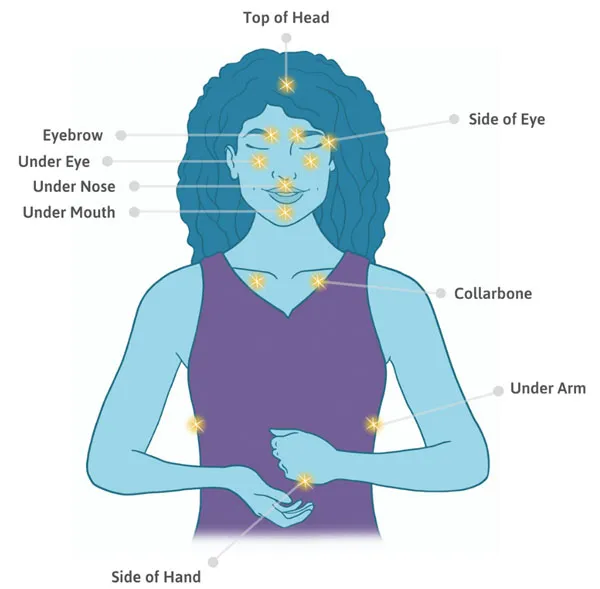
OK, so are you ready to do some Tapping? Before we start, take a deep breath in… and then out. I always find that starting with a deep breath helps to get my energy flowing and opens up my mind to better find what to tap on.
Calibration: On a scale of 0-10, how much do you feel that you are struggling to focus right now (0 being not at all, and 10 being you’re really struggling to focus)
We’ll start off with a very general round of Tapping, and then get into more specifics.
ROUND ONE: General Tapping
Starting on the Side of the Hand: “Even though I can’t focus, I accept myself anyway”
Again on the Side of the Hand: “Even though I just can’t seem to focus, I accept myself anyway”
One last time on the Side of the Hand: “Even though I really want to focus, but I just can’t seem to, I accept myself anyway”
Now we’ll go through all the points:
Eyebrow: “I can’t focus”
Side of the Eye: “I just can’t seem to focus”
Under the Eye: “I really want to focus”
Under the Nose: “But I just can’t seem to focus”
Under the Mouth: “I’m struggling to focus”
Collarbone: “I need to get things done”
Under the Arm: “I need to focus, but I just can’t seem to focus”
Top of the Head: “I can’t focus, but I accept myself anyway”
And now take a deep breath again.
Go ahead and calibrate again. On a scale of 0-10, how much do you feel that you are struggling to focus right now? Don’t worry if it’s close to the same, as we’re just getting started.
That was just a general round. Let’s get to tapping on some more specifics for you.
ROUND TWO: What are you distracted by?
When you think about focusing, what do you think might be getting in your way?
Is there something else in your life that is running in your mind that is taking away your focus? Are you worried about your finances? Or struggling with a relationship? Has something happened today that you’re upset about? Has anything happened recently that has changed your stress level, either up or down?
Fill in this sentence: I’m struggling to focus because in the back of my mind, I’m distracted by _____________.
OK, let’s do some tapping…
Starting on the Side of the Hand: “Even though I’m struggling to focus because I’m distracted by _______________, I accept myself anyway.” (If you can’t think of anything just say “…because I’m distracted by something, and I can’t figure out what it is…”
Again on the Side of the Hand: “Even though I just can’t seem to focus because in the back of my mind I’m thinking about ______________, I accept myself anyway”
One last time on the Side of the Hand: “Even though I really want to focus, but I just can’t seem to because I’m distracted by __________________, I accept myself anyway”
Now we’ll go through all the points:
Eyebrow: “I’m distracted by _______________”
Side of the Eye: “I just can’t seem to focus”
Under the Eye: “I really want to focus”
Under the Nose: “But I just can’t seem to focus because I’m distracted by ________________”
Under the Mouth: “I’m struggling to focus”
Collarbone: “I need to get things done”
Under the Arm: “I need to focus, but I just can’t seem to focus because I’m distracted by _________________”
Top of the Head: “Even though I can’t focus because I’m distracted by ___________________, I accept myself anyway”
Back to the Eyebrow: “I’m struggling to focus because I’m distracted by ________________.
Side of the Eye: “What if I let this distraction go?”
Under the Eye: “What if I allowed this distraction to go away for a little while, so I can focus?”
Under the Nose: “What if I allowed myself to focus for a little while?”
Under the Mouth: “I’m struggling to focus because I’m distracted by _____________, but I accept myself anyway”
Collarbone: “I’m really distracted by _____________ in the back of my mind, but I don’t have to be”
Under the Arm: “I can allow the noise of the distraction to quiet down for a little while, and allow myself to focus”
Top of the Head: “I can allow the distraction to quiet down for a little while, and allow myself to focus”
Go ahead and calibrate again. On a scale of 0-10, how much do you feel that you are struggling to focus right now?
Now at this point, depending on what has come up for you, you have the choice to continue tapping on the distraction that has come up, or you can move on. If things came up as you were tapping, I suggest continuing tapping on that to resolve it, if it’s something you can address.
If you have something big that has come up that needs a lot of attention, and you’re at the office with other people around you, it may not be the best time. That’s when it’s best to tap to allow the distraction to quiet down for now, to allow you to focus. If you have the time and space to tap on what has come up, then feel free to do that.
ROUND THREE: What if I can’t focus and complete the tasks? And what if I do?
Very often the stress of having to get certain things done prevents us from focusing. When we’re too tied to a certain outcome or result, it can inhibit our ability to focus and achieve what we want to get done.
So let’s ask ourselves some important questions: If I’m not able to focus and get this done, what will happen? How will I feel? Am I concerned about what somebody will think of me if I don’t get this done? If so, who is that and what am I worried they think or say about me? How will I feel towards myself? What emotions come up when you think about not being able to focus and not accomplishing what you need to get done?
So fill in the blank with what you think might happen: “If I’m not able to focus and get this done, ____________________”
And then let’s think about the flip side. If you are able to focus and get the task done that you’re wanting to focus on, what will happen? Is there any downside to completing the task? What is the upside to completing it? How will you feel about yourself? Is there anybody that will be happy that you were able to focus and is there anybody that will be upset?
So fill in the blank with what you think might happen if you do get it done: “If I am able to focus and get this done, _____________________”
OK, let’s get to some Tapping… 🙂 I asked a number of questions above that can bring up things to tap on. Find what is best for you to tap on. If you’re most concerned about what somebody will think of you, tap on that. Stressed about getting things done? Tap on that. Listen to your body when you answer the above questions and tap on the issue that is strongest for you.
For the purposes of this tapping, I’m going to focus on general stress and anxiety about focusing and getting the task or tasks done.
Starting on the Side of the Hand: “Even though I feel stressed and anxious about focusing and getting this done, I accept myself anyway” (feel free to replace with any other emotions that have come up for you)
Again on the Side of the Hand: “Even though I just can’t seem to focus, and I’m stressed and anxious about getting this done, I accept myself anyway”
One last time on the Side of the Hand: “Even though I really want to focus, but I just can’t seem to because I’m stressed and feel anxious about getting this done, I accept myself anyway”
Now we’ll go through all the points:
Eyebrow: “I’m really stressed about getting this done”
Side of the Eye: “I’m worried about not getting this done in time”
Under the Eye: “I’m stressed about there being so much to do”
Under the Nose: “What if I don’t get this done?”
Under the Mouth: “I have to get this done”
Collarbone: “But I’m just so stressed about getting this done”
Under the Arm: “I feel so stressed about getting a lot of things done!”
Top of the Head: “Even though I’m stressed about getting this done, I accept myself anyway”
Back to the Eyebrow: “Maybe I can take it one step at a time”
Side of the Eye: “What if I let some of this stress go?”
Under the Eye: “What if I allowed this stress to go away for a little while, so I can focus?”
Under the Nose: “What would happen if I actually was able to focus and get this done?”
Under the Mouth: “Even if I’m not able to focus and get this done, I accept myself anyway”
Collarbone: “What if I just did my best and allowed the stress and anxiety to go away?”
Under the Arm: “I can allow the stress and anxiety to quiet down for a little while, and allow myself to focus”
Top of the Head: “I can allow the stress to release from my body, and allow myself to focus”
Go ahead and calibrate again. On a scale of 0-10, how much do you feel that you are struggling to focus right now?
Those were just three quick rounds to get you going. Continue Tapping as you feel the need for anything else that came up for you.
Go here for an audio guided meditation on Clearing Distractions and Creating Focus.
Conclusion: Is Tapping Right for Your ADHD Journey?
EFT Tapping offers a promising, non-invasive approach to managing ADHD symptoms. Many individuals with ADHD find Tapping to be a valuable addition to their ADHD toolkit.
As with any new technique, it may take some time and practice to see results. Be patient with yourself and approach Tapping with an open mind. You may be surprised at the positive changes you experience in your focus, emotional regulation, and overall well-being.
If you want to understand more about why your brain gets stuck in these patterns, my book REWIRED walks through the nervous-system science behind focus and regulation.
Until next time… Keep Tapping!
Nick Ortner
What tapping can and can't do for ADHD
ADHD is a medical condition, and tapping doesn't treat it, cure it, or replace medication. What tapping is good for is the pile of feelings that tend to show up alongside ADHD: the overwhelm, the frustration, the shame after a mistake, the dread before a task you've been avoiding. Here's the plain breakdown.
| Tapping can help with | Tapping is not a substitute for |
|---|---|
| The wave of overwhelm when a task list feels like too much | ADHD medication or a prescriber's care |
| Frustration and self-criticism after a mistake or missed deadline | A formal ADHD diagnosis or evaluation |
| The dread that shows up before starting a boring or hard task | Therapy or coaching for executive function skills |
| The sting of rejection sensitivity after a comment or look | Behavioral treatment plans from a clinician |
| Calming your body enough to sit down and start | A cure for ADHD itself |
If you're working with a doctor, therapist, or ADHD coach, tapping is something you do alongside that care, not instead of it.
A 3-minute tapping round for ADHD overwhelm
This round is for the specific feeling of too many tabs open in your brain at once. Before you start, rate that feeling from 0 to 10, with 10 being completely overwhelmed. Tap through it once, then check the number again.
- Side of the Hand (1st time): "Even though I have too many tabs open in my brain right now, I accept myself anyway."
- Side of the Hand (2nd time): "Even though I can't tell what to do first, I accept myself anyway."
- Side of the Hand (3rd time): "Even though this overwhelm feels like too much, I accept myself and where I'm at right now."
- Eyebrow: "All these tabs open at once."
- Side of the Eye: "I don't know where to start."
- Under the Eye: "This overwhelmed feeling."
- Under the Nose: "Too much coming at me right now."
- Under the Mouth: "I don't have to solve all of it at once."
- Collarbone: "Just this next small thing."
- Under the Arm: "Letting some of these tabs close for now."
- Top of the Head: "One tab at a time, I accept myself anyway."
Take a breath and check your number again. If it's still high, run through the points a second time using whatever words came up for you. There's no rush here, and there's no wrong way to do it. If you want a visual to follow while you tap, here's a chart of the 9 tapping points.
Tapping phrases for the moments that come with ADHD
Some ADHD moments repeat often enough that it helps to have the words ready. Use these as a starting point, then swap in your own language for whatever is actually happening. For more on building your own setup statements and reminder phrases, see our guide to tapping phrases.
| Moment | Setup statement | Reminder phrase |
|---|---|---|
| Task paralysis | "Even though I'm frozen and I can't make myself start, I accept myself anyway" | "This frozen, stuck feeling" |
| Forgot something again | "Even though I forgot again and I feel like I'm failing, I accept myself anyway" | "This shame about forgetting" |
| Rejection sensitivity | "Even though that comment landed like a verdict, I accept myself anyway" | "This sting of rejection" |
| Before a boring task | "Even though I'm dreading this and I don't want to start, I accept myself anyway" | "This dread before I start" |
| After a hard day | "Even though today wore me out and I'm being hard on myself, I accept myself anyway" | "This tired, hard-on-myself feeling" |
What our data shows
Inside The Tapping Solution App, people rate how they feel from 0 to 10 before and after every session. We've measured that across more than 18 million sessions.
A peer-reviewed study of 270,461 App users, published in JMIR mHealth and uHealth in 2020 by Church and Stapleton, found that a single tapping session brought anxiety down 44% and stress down 45% on average.[3] None of that research was done specifically on ADHD, but the emotional load tapping is measuring there (anxiety, stress) overlaps with a lot of what ADHD brings up day to day. If anxiety is a big piece of what you experience, our guide to tapping for anxiety relief goes deeper on that.
If you want to feel the difference for yourself, try this free tapping session.
Frequently Asked Questions
Does tapping help with ADHD?
Tapping doesn't treat ADHD itself, but it can help with the stress, overwhelm, and self-criticism that often come with it. Many people find that once the emotional charge around a task drops, the task itself feels more manageable.
Can tapping replace ADHD medication?
No. Tapping is not a substitute for medication or any treatment your doctor has prescribed. Use it alongside your care, not in place of it.
How do I tap when I can't sit still?
You don't have to sit still to tap. Tapping is a physical, active practice, so pacing, standing, or fidgeting while you tap is fine. For many people with ADHD, that movement is part of what makes it easier to stick with than a seated meditation.
Can kids with ADHD tap?
Yes, with an adult's guidance. Keep the words simple and let the child lead on what they're feeling. Tapping is gentle and there's no needles or equipment involved, just fingertips on a few points on the face, hands, and body.
How long before I notice anything?
Some people notice a shift within a single round, especially with a specific feeling like overwhelm before a task. Bigger patterns, like years of shame around forgetfulness, usually take more consistent practice over days or weeks.
What about tapping for focus?
Tapping doesn't create focus directly. What it does is clear out the stress, dread, or self-criticism that's crowding your mind, and focus tends to come back more easily once that noise quiets down. See the "How to use Tapping for ADHD" section above for a full sequence built around this.
References
- Stapleton P, Crighton G, Sabot D, O’Neill HM. Reexamining the effect of emotional freedom techniques on stress biochemistry: A randomized controlled trial. Psychol Trauma. 2020;12(8):869-877.
- Bach D, Groesbeck G, Stapleton P, Sims R, Blickheuser K, Church D. Clinical EFT (Emotional Freedom Techniques) Improves Multiple Physiological Markers of Health. J Evid Based Integr Med. 2019;24:2515690X18823691. doi:10.1177/2515690X18823691
- Church D, Stapleton P. Cortisol and Self-Reported Levels of Anxiety and Stress in App-Based EFT Tapping. JMIR mHealth uHealth. 2020;8(10):e18988.