
Your heart pounds. Sweat beads on your forehead as the room seems to tilt. Your breath comes in short, painful gasps, and one thought races through your mind: “What's happening to me?” If you've ever felt a panic attack take over, you know exactly how fast and how frightening that moment is.
Tapping (EFT, or Emotional Freedom Techniques) combines gentle pressure on specific acupoints with naming what you're feeling out loud. It's a tool you can use the moment panic starts, alongside any care you're already getting from a doctor or therapist, not instead of it.
If you want to start tapping right now, skip to the in-the-moment round below. If you have chest pain that spreads to your arm, jaw, or back, or you're not sure whether what you're feeling is panic or something medical, treat it as an emergency and call emergency services first. The table further down walks through how to tell the difference.
In this comprehensive guide, we'll explore how to use Tapping for panic attacks, diving deep into the technique and providing you with practical steps to find calm when you need it most, so you have the tools to prevent or relieve a panic attack next time you feel one coming.
The fastest round: tapping through a panic attack right now
You don't need the perfect words. Tap through these points, using short phrases, and check in with your breath after each round.
- Setup (side of hand, x3): “Even though I'm panicking right now, I'm safe in this moment.”
- Setup (side of hand, x3): “Even though my body feels out of control, I accept how I feel right now.”
- Setup (side of hand, x3): “Even though this is scary, I am safe enough to breathe.”
- Eyebrow: This panic
- Side of the Eye: This fear
- Under the Eye: My heart is racing
- Under the Nose: I can't catch my breath
- Under the Mouth: This feeling in my body
- Collarbone: I am safe right now
- Under the Arm: I'm letting this pass through me
- Top of the Head: I am okay
Take a slow breath. If you're still at a high number, go through the points again. If you have chest pain, or anything feels different from a panic attack you recognize, stop and get medical help instead of doing another round.
Understanding panic attacks
Before we get into the how-to of Tapping, let's briefly understand what panic attacks are.
Panic attacks are sudden, intense surges of fear, panic, or anxiety that involve physical and psychological symptoms. They can be triggered by specific situations or can occur unexpectedly.
Common symptoms include:
- Rapid heartbeat
- Shortness of breath
- Chest pain or tightness
- Dizziness
- Sweating
- Nausea
- Trembling or shaking
- Feeling of impending doom or danger
- Fear of losing control
While the exact cause isn't always clear, several factors can contribute:
- Chronic stress: Prolonged periods of stress can make you more susceptible to panic attacks.
- Traumatic experiences: Past traumas can trigger panic attacks, especially in situations reminiscent of the traumatic event.
- Major life changes: Significant life events, both positive and negative, can increase the likelihood of panic attacks.
- Family history: Anxiety disorders can run in families, so if you have a relative with panic disorder you may be at increased risk.
- Brain changes: Certain changes in the brain may play a role in panic attacks.
- Medication use or withdrawal: Caffeine, alcohol, and certain drugs can trigger panic attacks, as can withdrawal from these substances.
- Cognitive factors: Catastrophic thinking or overthinking patterns or misinterpretation of bodily sensations can lead to panic attacks.
Panic attack, anxiety, or a medical emergency?
Panic attacks and anxiety can feel similar to a medical event, and it's not always obvious which one you're having. This is a general guide, not a diagnosis.
| Panic Attack | Anxiety | Possible Medical Emergency | |
|---|---|---|---|
| Onset | Sudden, peaks within minutes | Builds gradually, can linger for hours | Sudden, often during or after exertion |
| Chest feeling | Tight or fluttery, sometimes sharp | Tension or a knot, rarely sharp | Pressure or squeezing, like weight on the chest |
| Where it spreads | Stays in the chest area | Stomach, shoulders, jaw from muscle tension | Arm, jaw, neck, shoulders, or back |
| Duration | Usually resolves within 20 to 30 minutes | Can last hours to days | Persists or comes and goes, doesn't fully resolve |
| What helps | Tapping, slow breathing, grounding | Tapping, addressing the underlying stressor, professional support | Call emergency services right away |
If you have chest pain, or you aren't sure whether what you're feeling is panic or something medical, call emergency services or go to the nearest ER. Don't assume it's panic and wait it out.
Free. The best place to start.
Want to learn tapping from the people who know it best?
The Tapping World Summit has taught tapping to people all over the world since 2009. Ten days, 24 of the world's leading tapping teachers, 100% free.
Join the free summitHow Tapping works for panic attacks
Tapping is a simple yet effective technique that helps regulate your nervous system, bringing your body out of the fight-or-flight stress response often associated with panic and anxiety.
The process works through several interconnected mechanisms.
Firstly, tapping on specific acupoints sends calming signals to the amygdala, the brain's alarm center. At the same time, you're also focusing on your feelings and acknowledging your anxiety. The process also incorporates other evidence-based psychological strategies like concepts from exposure therapy, making it a comprehensive approach to anxiety management. By engaging both your body and mind, Tapping can quickly shift you out of panic mode and into a more balanced emotional state.
As you tap and acknowledge your feelings, you're essentially telling your brain, “I'm safe, even though I feel anxious right now.”
If it's the raw physical sensation of feeling unsafe that grips you hardest, our panic first-aid guide to tapping for the physical feeling of being unsafe walks through that in-the-moment process step by step.
Research backs this up: studies show that just one hour of Tapping can reduce cortisol (the stress hormone) levels by 43%. This significant drop in stress hormones may explain why Tapping can often provide almost immediate relief from the physical symptoms of anxiety and panic.
It’s incredible what a difference just a few minutes of Tapping can make. Our users report a 40% average reduction in anxiety after just 9 minutes when using our Releasing Anxiety Tapping meditation. If you want to build on that with a structured plan, take a behind-the-scenes look at the app's 5-Day Release Anxiety Program.

Regular practice of Tapping can also lead to long-term changes in how your brain responds to stress. Through neuroplasticity (the brain's ability to form new neural connections), Tapping can help your brain create new, calmer responses to situations that previously triggered panic or anxiety. It's like retraining your brain to stay calm under pressure.
This makes Tapping for anxiety relief super helpful as a preventative measure for things like fear of flying, fear of the dentist, social anxiety, and more.
Where to tap for anxiety and panic attacks: understanding the Tapping points
So, how can we use Tapping to prevent or relieve panic attacks?
Tapping involves using your fingertips to gently tap on certain acupoints on the body, some of the same points used in acupressure and acupuncture.
While there are thousands of acupoints on the body where meridians can be accessed, you'll use a set of nine traditional Tapping points when doing EFT Tapping for panic attacks:
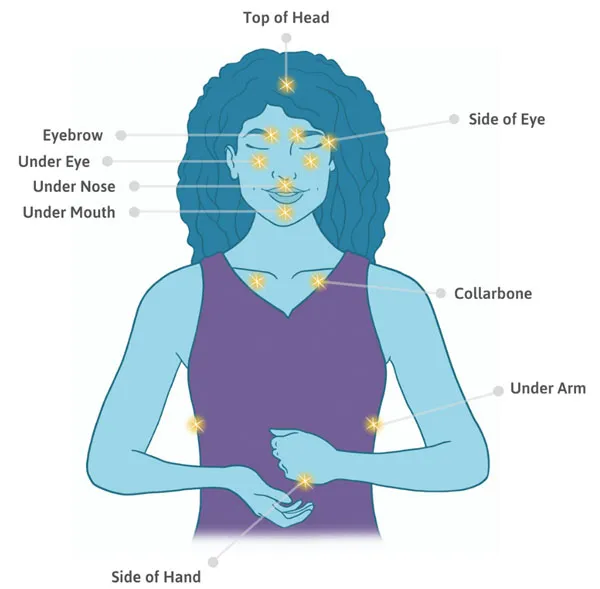
- Side of the Hand (Karate Chop): This is the fleshy, narrow side of the hand on the side of the pinky finger.
- Eyebrow: On the brow bone where the eyebrows begin, closest to the bridge of the nose.
- Side of the Eye: On the bone directly along the outside of either eye.
- Under the Eye: On the bone directly underneath either eye.
- Under the Nose: The area directly beneath the nose and above the upper lip.
- Under the Mouth: This is the area just below your bottom lip and above the chin, right in the crease.
- Collarbone: Starting from where your collar bones meet in the center, go down an inch and out an inch on either side.
- Under the Arm: On your side, about four inches beneath the armpit.
- Top of the Head: Directly on the crown of your head.
Each point corresponds to different meridians in the body and can help address various aspects of anxiety and panic.
Now that you know where to tap for anxiety, let’s walk through the process.
How to do Tapping for panic attacks: A step-by-step guide
When you're experiencing a panic attack or intense anxiety, follow these steps to use Tapping to calm down:
- Assess Your Anxiety Level: Rate your anxiety or panic on a scale from 0-10, with 10 being the most intense.
- Create a Setup Statement: Acknowledge your feelings while accepting yourself. For example, “Even though I'm feeling this intense panic, I deeply and completely accept myself.”
- Begin Tapping: Start tapping gently on the side of your hand while repeating your setup statement three times.
- Tap through the points: Gently tap about 5-7 times on each of the remaining points while focusing on how you feel. Follow this sequence:
- Eyebrow
- Side of the eye
- Under the eye
- Under the nose
- Under the mouth
- Collarbone
- Under the arm
- Top of the head
- Focus on Your Feelings: As you tap, focus on the physical sensations and thoughts associated with your panic or anxiety.
- Use Reminder Phrases: At each point, use short phrases to keep your focus, such as “This feeling of dread,” or “This panic,” or “This tightness in my chest.” Repeat these in your mind or out loud.
- Take a Deep Breath and Reassess: After completing one round, take a deep breath and rate your current anxiety level again.
- Repeat as Necessary: Continue tapping through all the points until you feel a reduction in your anxiety or panic symptoms.
For an in-depth guide on how to Tap, go here.
Remember, there's no "perfect" way to tap. The key is to maintain a rhythm and focus on your emotions as you go through the points.
- Instantly reduce anxiety and stress
- Fall asleep faster and sleep better
- Boost productivity, stay motivated
- Relieve chronic or occasional pain
- Release anger, find peace


Tapping phrases for anxiety and panic attacks
The phrases you use while Tapping can significantly impact the effectiveness of the technique. Here are some examples of Tapping phrases for anxiety and panic attacks:
“Even though I feel this panic rising in my chest, I choose to remain calm and centered.”
“This anxiety feels overwhelming, but I am safe and in control.”
“My mind is overthinking and assuming the worst, but I choose to remember I am safe.”
“I release this fear and allow peace to fill my body.”
“My body knows how to relax, and I allow it to do so now.”
“I am stronger than this panic, and it will pass.”
To experience a Tapping meditation in action, follow along with me in this guided Tapping for anxiety session.
When to expect results from Tapping for panic attacks
Many people experience some level of relief in minutes when they use Tapping for anxiety. For others, it can take repeated practice to notice a shift.
Remember, like any skill, Tapping becomes more effective with practice. Don't be discouraged if you don't see immediate results. With consistency and patience, you may find that Tapping becomes an invaluable resource in your anxiety management toolkit.
And before long, you’ll find yourself breathing easier and feeling more in control, no matter what life throws your way.
Curious what it’s like to use Tapping for panic attacks? Here’s a first-hand account of someone who used Tapping to stop their panic attacks. And here’s a story from a mom who helped her 12-year-old son find calm in the middle of an anxiety attack.
What our data shows
Inside The Tapping Solution App, people rate how they feel from 0 to 10 before and after every session.
Our closest match for this exact moment, Stop a Panic Attack, has been completed 35,102 times, with the average rating dropping from 7.4 to 5.0.
Zoomed out across the broader Emotional Freedom category (58 anxiety and stress sessions, 4,022,551 completions), the average rating drops from 7.0 to 4.1, a 42% drop.
A peer-reviewed study of 270,461 App users, published in JMIR mHealth and uHealth (Church & Stapleton, 2020), found anxiety dropped 44% and stress dropped 45% in a single session.
A meta-analysis pooling 14 randomized trials and 658 people found tapping produced a larger drop in anxiety symptoms than the comparison groups saw (Clond, 2016). See the study on our Evidence Atlas.
A randomized trial found cortisol, the body's main stress hormone, fell 43% after a single 60-minute tapping session, compared with 20% after a psychoeducation session (Stapleton et al., 2020). See the study on our Evidence Atlas.
“I have been carrying this anxiety ever since whenever I come into crowds, over-hanging trees, sudden unexpected loud noises, and unfamiliar places. This session seems to lessen my heightened anxiousness. I feel relaxed and safe—more so than with my psych counselor.”
“I did this tapping and feel lighter and less panicked.”
More support for your nervous system
- The Basic Tapping Sequence for Anxiety, Step by Step
- Nervous System Dysregulation: 12 Signs and How to Recover
- Vagus Nerve Tapping: A Complete Guide to Natural Nervous System Regulation
- EFT Tapping Chart: Getting to Know the 9 Main Tapping Points
- EFT Tapping Phrases: Your Complete Guide to Effective Tapping Sessions
You can also read Trina's story, about how tapping helped her calm severe panic attacks.
Panic Attacks and Tapping: Your Questions, Answered
Can tapping stop a panic attack?
Many people use tapping the moment a panic attack starts and find it helps their body settle within minutes. Tapping is not a cure for panic disorder; it works best alongside care from a doctor or therapist.
Is a panic attack dangerous?
A panic attack itself is not dangerous, even though it can feel like an emergency. The exception is chest pain. If you have chest pain, or you are not sure whether what you feel is panic or something medical, treat it as an emergency and call emergency services.
How can I tell a panic attack from a heart attack?
A panic attack usually peaks within minutes and fully resolves within 20 to 30 minutes, with pain that stays in the chest. A heart attack often brings pressure or squeezing that spreads to the arm, jaw, neck, or back, and it does not fully go away. When in doubt, call emergency services first and sort out which one it was afterward.
What if my panic attacks keep happening?
If panic attacks are frequent or severe, or they are starting to limit what you do, talk to a doctor or therapist. Tapping can help in the moment and alongside that care, but it is not a replacement for a diagnosis or a treatment plan.
What do I tap and say during a panic attack?
Start at the side of your hand with a short setup statement that names what is happening, such as "Even though I'm panicking right now, I'm safe in this moment." Then tap through the points with short reminder phrases like "this panic" or "my heart is racing." You do not need the full sequence or exact words in the moment, short and repeated is enough.
How long do panic attacks usually last?
Most panic attacks peak within about 10 minutes and resolve within 20 to 30 minutes. If a panic attack does not ease, or new symptoms appear that feel different from past episodes, treat it as a reason to seek medical care rather than waiting it out.
Does tapping work instead of medication for panic disorder?
Tapping is not a substitute for medication or any treatment your doctor has prescribed. Use it in the moment, alongside whatever care plan you already have. Never change or stop medication without talking to your prescriber.
Now part of a Medicare program
If you're on Original Medicare, one more option. NeuroTap Health, our sister company, offers a guided tapping program for adults living with anxiety at $0 out of pocket through a Medicare program. It walks you through sessions in order, week by week, so you're not figuring it out alone at 2am. Here's who qualifies.
Ready to try Tapping for your panic attacks?
Panic attacks and anxiety can be challenging to manage, but Tapping offers a powerful, accessible tool for finding relief. By combining ancient wisdom with modern psychology, this technique provides a holistic approach to calming your mind and body. It works quickly and is extremely effective.
Download The Tapping Solution App for free today to explore guided Tapping meditations specifically designed to help with anxiety and panic.
Here are a few options to get started with in the app:


If you want a complete system beyond a single session, our Tapping Solution for Anxiety Relief program walks through six modules built specifically for this.
Until next time… Keep Tapping!
Nick Ortner


