If you are new to the idea of Tapping, it might seem a little bit strange. You might be wondering, “Does Tapping really work?”
Here's the short answer: yes, for stress and anxiety, tapping has real support from randomized trials. The likely mechanism is simple: tapping on acupressure points while you focus on what's bothering you appears to send your brain's stress-response center a signal that it's safe to calm down. What's still open is exactly how much of the effect comes from the points themselves versus the focused attention and exposure built into the process, and that's an honest gap in a newer field of research, not a reason to dismiss what the trials do show.
Read on to learn more about what Tapping is and discover the science and research behind this evidence-based approach to stress relief and healing.
What Is EFT Tapping?

Tapping, also known as EFT (Emotional Freedom Techniques) is a practice that combines the principles of ancient Chinese acupressure and modern psychology.
The EFT technique involves using your fingertips to tap on specific acupressure points along the body’s meridians.
While you tap on the EFT Tapping points, you focus on the emotions or physical sensations that are causing you distress. You might think or speak about your anxiety, a fear, or a physical pain, for example, as you move through the Tapping sequence. (You can read more about the Tapping technique on our Tapping 101 page.)
The idea is to help calm down your nervous system and rewire the brain to respond in a more productive way to whatever is distressing you.
Tapping and the Brain - The Role of the Amygdala
Tapping affects the part of the brain responsible for our stress response, the amygdala. The amygdala helps us react to stressful situations. It sends us into fight-or-flight mode so that we can stay safe in an emergency and avoid danger.
Unfortunately, in modern times, the amygdala’s survival instinct is activated way too often. And it is triggered in everyday situations where we aren’t under any real threat.
So when you experience a stressful event, or even when you think of something that is stressful (or something that contributes to pain, anxiety, or discomfort), it triggers the amygdala to set off its fire alarm. But when you practice Tapping, you think about the things that are causing you stress while also sending a calming signal to the brain, letting it know it is safe to relax.
Through Tapping, we ultimately allow our brains and bodies to relax. This helps us let go of whatever might be causing us stress, anxiety, pain, or discomfort and find greater peace and ease.
But does Tapping really work? And can it actually make a difference for you? Let’s find out...
Does Tapping Really Work? Exploring the Science Behind Tapping

First, I can personally say with certainty that I know Tapping works. I’ve seen it a hundred times over in the people I’ve worked with. In fact, I believe so deeply in Tapping that I’ve built my entire career around sharing it with as many people as I can: hoping that they, too, can benefit from this amazing tool.
But you don’t have to just take my word for it. Tapping is an evidence-based method that is grounded in science and research.
More than 100 studies have been published in peer-reviewed journals on the effectiveness of EFT for anxiety, stress, depression, cravings, pain, PTSD, fears, and so much more.
For example, one 2019 study found that a 4-day workshop in EFT Tapping decreased the participants’ pain levels by 57%, anxiety by 40%, depression by 35%, and cravings by 74%, while also increasing their happiness levels by 31%.[1]
Pretty incredible, right?
But that’s just one of many Tapping research studies that show some really promising results. Here are just a few more examples of what the research has found about the benefits of Tapping for common concerns.
Science-Based Benefits of Tapping:
- Anxiety. A systematic review and meta-analysis of studies on Tapping for anxiety suggested that EFT leads to significant reductions in anxiety scores.[2]
- Depression. A review study from 2016 found that Tapping was highly effective in reducing symptoms of depression in a variety of situations. In fact, the effects were as good as, if not better than, standard depression treatments like medications and therapy. The results of the study showed an average reduction in symptoms of 41% when using Tapping for depression![3]
- Sleep. A study in older people found Tapping to be effective for treating insomnia.[4]
- Cravings and weight loss. A study in overweight and obese adults showed that a 4-week EFT treatment led to reductions in food cravings even six months later, and improved body weight, BMI, and feelings of having “power over food” even when re-tested 12 months later.[5]
- Pain. People who participated in a 4-day EFT training workshop experienced a 57% reduction in pain levels.[1] And another study in a group of healthcare workers showed that pain levels dropped significantly immediately following EFT Tapping, with improvements in pain ratings lasting for several months after as well.[6]
- Headaches. Researchers found that people with tension-type headaches who were taught EFT and used it twice a day for two months were able to see reduced intensity and frequency of their headache episodes.[7]
And like I said, over 100 clinical studies on Tapping have been done at this point to validate the effectiveness of the technique. So what you see in the list above is just scratching the surface.
There are many more examples to draw from, showing that Tapping really can make a difference in a wide variety of mental and physical health concerns.
Please note: As always, if you are experiencing any physical or mental health concerns, consult with a doctor, therapist, or other qualified health practitioner. This information is not intended to be a substitute for professional medical advice.
But wait, there’s more! The research on Tapping also shows that Tapping is actually associated with positive biochemical changes within the body, too.[10]
Free. The best place to start.
Want to learn tapping from the people who know it best?
The Tapping World Summit has taught tapping to people all over the world since 2009. Ten days, 24 of the world's leading tapping teachers, 100% free.
Join the free summitHow Tapping Works to Positively Affect Your Physiology

So, does Tapping really work? The large body of research studies we’ve just learned a little bit about sure provides a lot of supporting evidence that it does. People with a variety of different concerns tend to feel very different before and after Tapping.
But does Tapping actually create measurable differences in the body? It turns out that yes: when we Tap, we can create positive changes in the body’s biochemistry.
More and more, we are seeing exciting research published on Tapping that investigates how it can affect things like hormone levels, heart rate, blood pressure, and more.

His study found that EFT Tapping led to a reduction in cortisol levels by 24% and that it had a bigger effect than the traditional stress management method of psychotherapy.[8]
In 2020, another group of researchers led by Dr. Peta Stapleton looked to replicate the results from that original study. And remarkably, their results suggested that EFT Tapping for stress reduced cortisol levels by 43%, after just one hour of Tapping![9]
Tapping has also been linked to reduced resting heart rate, systolic blood pressure, and diastolic blood pressure.[1]
This research shows us that Tapping promotes physical, and measurable, changes in our body’s biochemistry. How amazing is that? So not only do people report feeling better after Tapping, but these studies show that physiological changes within the body occur as well.
Why Does Tapping Work So Well?

There’s a lot more to learn about Tapping and the scientific mechanisms behind its effectiveness. But as we can see from the research so far, it really does work, and it works well!
One of the reasons I believe Tapping is so effective for reducing stress and anxiety is that it doesn’t just manage your stress on the surface level. Instead, Tapping helps to actually regulate the brain’s stress response.
Tapping is really effective at putting your body into a relaxed state where it feels safe. This helps us to feel our feelings, face our fears, process our difficult memories, and so on. And in the process, it helps us to rewire the brain so that it knows we are not in real danger. It reminds the brain that it can calm down, let go, and get back to helping us feel better.
Because of this, Tapping allows us to truly let go of our stress or difficult emotions, allowing us to move forward with greater ease. It can lead to major breakthroughs and long-lasting transformation.
Tapping is also a true mind-body approach, working on the physical, mental, and emotional levels. As Dr. Dawson Church once explained,
“EFT gives you the best of both worlds (body and mind) like getting a massage during a psychotherapy session.”
And finally, I believe part of the power of Tapping is that it works really quickly. In just minutes, the Tapping technique has the power to really make a difference in how you feel. That's something that other therapeutic healing tools can take weeks or months to achieve.
Give Tapping a Try for Yourself
If you are new to Tapping and have been wondering, "Does Tapping really work?" - then I encourage you to give it a chance and see for yourself!
Aside from the evidence-based benefits we’ve talked about already, Tapping also offers these advantages:
- It doesn’t take a lot of time to do, you can feel a shift in just a few minutes.
- It is very simple and easy to apply.
- You don’t need any special tools or equipment: you can do it yourself, wherever you are, whenever you want to.
- It is free to learn and free to practice, making it a low-cost solution.
- It puts the power to heal and feel better back into your own hands.
Check out The Tapping Solution App
If you are ready to learn how to Tap, a great place to start is our app, The Tapping Solution App.
There are many different Tapping Meditations in the App to choose from, on topics ranging from releasing anxiety to healing your body to improving your sleep. The meditations will guide you through the Tapping process, taking the guesswork out of it.
And in case you are still wondering, “But does Tapping really work?” Here’s one more piece of evidence you might find intriguing.
When we look at data from our own app users, we find that on average, people report a 44% reduction in anxiety and a 45% reduction in stress after a guided Tapping Meditation session. In a peer-reviewed study of 270,461 Tapping Solution App users, self-rated anxiety dropped from 6.66 to 3.75 on a 0-10 scale (Church & Stapleton, 2020, JMIR mHealth and uHealth).
Ultimately, Tapping really can be a powerful tool for positive change and healing. I can’t wait to hear how it works for you!
Until next time...
Keep Tapping!
Nick Ortner
The Tapping Solution App
Get started free with The Tapping Solution App
Guided tapping meditations for anxiety, sleep, stress, and more. Try it free.
What the research says, at a glance
Here's a short table of the studies behind the claims above, so you can check the sourcing yourself instead of taking our word for it.
| Study | Year | Design | N | What it found |
|---|---|---|---|---|
| Schwarz & Stapleton | 2026 | Peer-reviewed mechanism framework (Frontiers in Psychology) | Theoretical framework, not an outcome trial | First paper to name 7 active ingredients and 4 mechanisms of change in Clinical EFT, including memory reconsolidation |
| Clond, M. | 2016 | Systematic review with meta-analysis (J Nerv Ment Dis) | Meta-analysis across published anxiety trials; N not stated in our proof library | Anxiety effect size d=1.23, described as 2-3x stronger than standard psychological interventions |
| Feinstein, D. | 2025 | Review of physiological mechanisms | Not stated in our proof library | Synthesizes the physiological mechanisms behind tapping's measured effects |
| Rogers, R. & Sears, S. | 2015 | RCT, dismantling design, EFT for stress in students; no confirmed Evidence Atlas page for this citation | Not stated in our proof library | Tapping location mattered for stress reduction, a second sham-controlled result pointing away from pure placebo |
One note on this table: the mechanism and physiological-review papers are newer and don't report a participant count the way a clinical trial does. Every study in the table has its own record on our Evidence Atlas, including the sham-controlled trial (Rogers & Sears, 2015).
What the skeptics say, and what the studies show
If you've heard tapping called pseudoscience, here's where that label comes from and why it doesn't tell the whole story. Early EFT proponents explained the technique using "energy meridian" language borrowed from Chinese medicine, and mainstream science doesn't accept that theory as written. That's a fair criticism of the original explanation. But it isn't the same as saying the results aren't real, and the research that followed largely moved past the energy-meridian framing to explain tapping through more familiar mechanisms: focused exposure to the thing that's bothering you, cognitive reframing, and a calming signal sent to the amygdala, the brain's threat center.
"It's just placebo." This is the most serious version of the skeptic's case, and it deserves a real answer rather than a dismissal. The standard way researchers test for placebo is a sham-controlled study: one group taps on the real EFT points, another group taps on fake, non-meridian points or performs a similar but different motion, and researchers compare the results. Rogers & Sears (2015) ran this exact design with 56 stressed university students: the group tapping on real points saw a 39% drop in stress, the sham-point group 8%, with everything else about the session kept the same (study record). If tapping worked purely through suggestion or relaxation, the sham group should have done just as well. It didn't.
"It's just publication bias." No field of research is fully immune to the tendency for positive results to get published more often than null ones, and tapping research is no exception. The best defense against that isn't any single flashy study, it's independent replication across many separate trials, which is exactly what a meta-analysis like Clond (2016) pools together, and it's why we've pointed you to a table of several different studies above rather than one favorite result.
We'd rather say plainly where the evidence is thinner than oversell it: the newest mechanism work explaining exactly how tapping affects the brain is still developing, and the sham-controlled dismantling studies above are smaller-scale trials, not large multi-site RCTs. None of that erases what the meta-analyses and biomarker studies elsewhere on this page do show. It just means "does tapping work" and "do we fully understand why it works" are two different questions, and this page tries to answer both plainly.
Worth noting too: EFT was first developed by psychotherapists, and it's continued to be used and taught by mental health professionals and CBT clinicians in the decades since, it isn't a fringe technique with no clinical footprint. And across the research summarized on this page, tapping shows no known pattern of making things worse; the open questions are about mechanism and scale, not safety.
What our app data shows
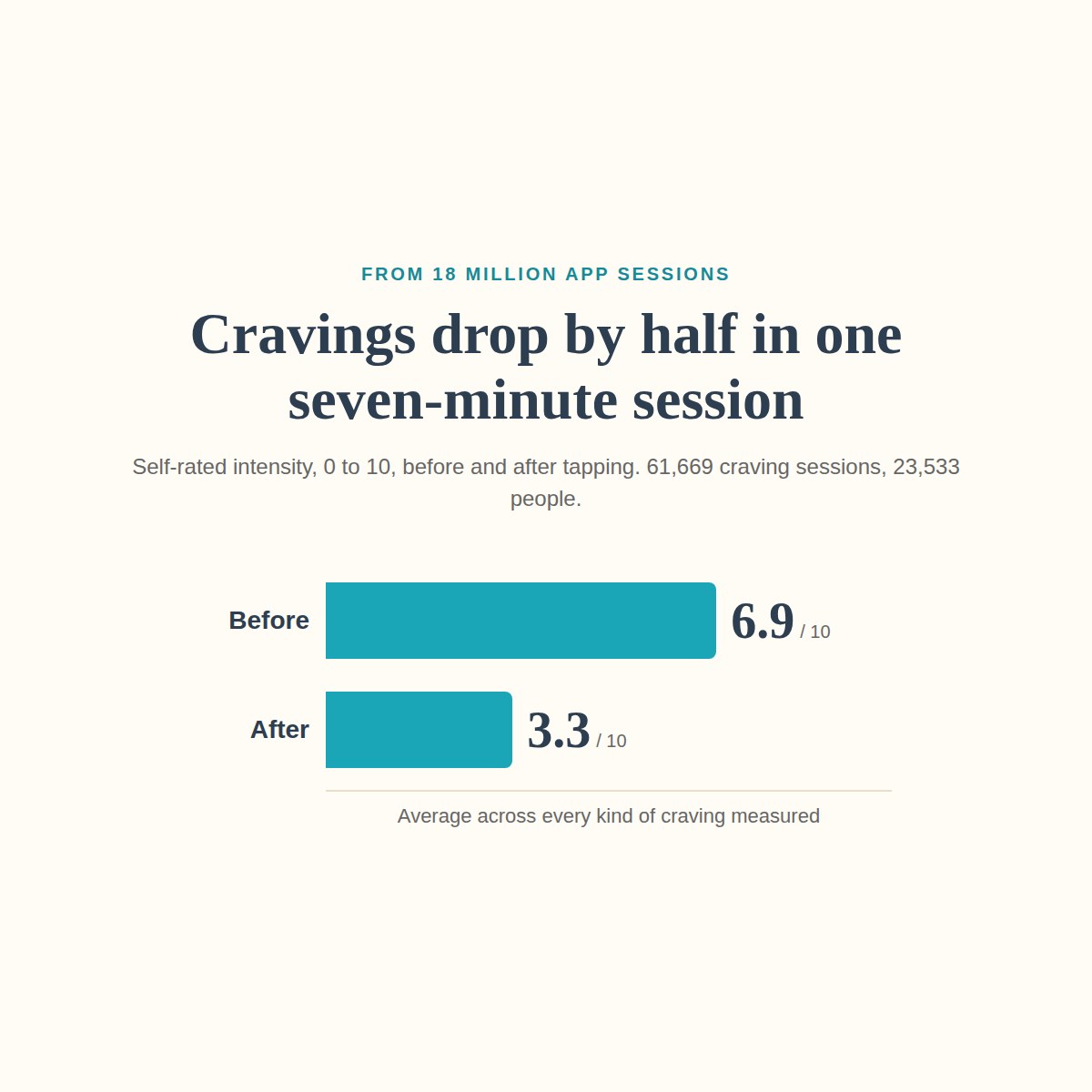
Beyond any single study, our own usage data is another data point worth looking at plainly. More than 32 million tapping sessions have been completed in The Tapping Solution App, and more than 18 million of those included a before-and-after rating, so we could actually measure a change rather than just count downloads. Across our Emotional Freedom category, the 58 sessions built around processing difficult feelings, people have completed 4,022,551 sessions, with the average intensity rating going from 7.0 to 4.1, a 42% drop, in a single session. And in the peer-reviewed JMIR study cited above, 270,461 App users saw self-rated anxiety and stress drop 44% and 45%.
This is self-reported, in-the-moment app data, not a controlled clinical trial on its own. But at this scale, it's the largest tapping-and-outcomes dataset that exists anywhere, and it points the same direction as the research above. If you want to see what a first session actually feels like, Intro to Tapping and The App is a good place to start.
What people say
"Absolutely baffled! I'm literally fighting tears of joy to write this."
Brandi, a lifelong-anxiety skeptic before she tried tapping, rated her anxiety an 8 before this session, a 1 after
"Your timing in my life at this moment is a miracle."
Christina, Instant Boost of Happiness, rated how she felt a 10 before the session, a 0 after
Go deeper
- 5 Surprising Ways Tapping Affects Your Body (That Science Has Confirmed)
- EFT Debunked: The Truth About Emotional Freedom Techniques (aka Tapping)
- Tapping for Depression: Unlocking the Benefits of EFT
- Research Spotlight: Tapping Proves an Effective Addition to Addiction Treatment
- Research Feature: Tapping for Reducing the Fear of Childbirth
- EFT Tapping Chart: Getting to Know the 9 Tapping Points
- EFT Tapping Phrases: Your Complete Guide to Effective Tapping Sessions
- EFT Tapping Scripts: A Powerful Stress Relief Technique You Can Use Today
- Carl's story: the ultimate skeptic became a believer
- How Tapping Works, on our main site
Tap along with me
If you want the research laid out in plain language, watch this video next.
Does Tapping Really Work? Your Questions, Answered
Does tapping really work?
Yes, within the limits of what the research has tested so far. Multiple peer-reviewed studies, including a 2016 meta-analysis and newer mechanism research, link tapping to real reductions in anxiety and stress, and data from more than 32 million completed sessions in The Tapping Solution App points the same direction. It is not a cure for any diagnosed condition, and it works best alongside good self-care and, when you need it, a clinician's care.
Is tapping just placebo?
The best test so far says no. A randomized dismantling study of 56 stressed students compared real acupoint tapping with tapping on sham, non-meridian points and found a 39% drop in stress for the real points versus 8% for the sham points (Rogers & Sears, 2015).
How does tapping work in the brain?
Tapping combines pressure on specific points with focused attention on what's bothering you, which appears to send the brain's stress-response center, the amygdala, a signal that it's safe to stand down. A 2026 paper in Frontiers in Psychology identified several likely mechanisms behind this, including memory reconsolidation, though researchers are still working out the full picture.
What does the research say?
More than 100 peer-reviewed studies have looked at tapping for anxiety, stress, depression, cravings, pain, and PTSD. A 2016 meta-analysis found a strong effect size for anxiety, and a peer-reviewed study of 270,461 Tapping Solution App users found average drops of 44% in anxiety and 45% in stress after a guided session. Some findings, especially on exactly how tapping works in the brain, are newer and still developing.
Does tapping work for everyone?
Not equally, and not instantly, the same as any technique. App data shows most people report a real drop in how intense a feeling is within one session, but individual results vary, and tapping is not a substitute for treatment of a diagnosed medical or mental health condition.
How fast does tapping work?
Often within minutes. Many people notice a shift in how intense a feeling is by the end of a single round, though a long-standing pattern usually takes more than one session to fully settle.
References
- Bach D, Groesbeck G, Stapleton P, Sims R, Blickheuser K, Church D. Clinical EFT (Emotional Freedom Techniques) Improves Multiple Physiological Markers of Health. J Evid Based Integr Med. 2019;24:2515690X18823691. doi:10.1177/2515690X18823691
- Clond M. Emotional Freedom Techniques for Anxiety: A Systematic Review With Meta-analysis. J Nerv Ment Dis. 2016;204(5):388-395. doi:10.1097/NMD.0000000000000483
- Nelms JA, Castel L. A Systematic Review and Meta-Analysis of Randomized and Nonrandomized Trials of Clinical Emotional Freedom Techniques (EFT) for the Treatment of Depression. Explore (NY). 2016;12(6):416-426. doi:10.1016/j.explore.2016.08.001
- Lee JH, Chung SY, Kim JW. A comparison of Emotional Freedom Techniques-Insomnia (EFT-I) and Sleep Hygiene Education (SHE) in a geriatric population: A randomized controlled trial. Energy Psychology: Theory, Research, and Treatment, 2015;7(1):1-8.
- Stapleton P, Sheldon T, Porter B. Clinical Benefits of Emotional Freedom Techniques on Food Cravings at 12-Months Follow-Up: A Randomized Controlled Trial. Energy Psychology Journal, 2012;4(1):13-24.
- Church D, Brooks AJ. The effect of a brief EFT (Emotional Freedom Techniques) self-intervention on anxiety, depression, pain and cravings in healthcare workers. Integr Med Clin J. 2010;9(5):40-44.
- Bougea AM, Spandideas N, Alexopoulos EC, Thomaides T, Chrousos GP, Darviri C. Effect of the emotional freedom technique on perceived stress, quality of life, and cortisol salivary levels in tension-type headache sufferers: a randomized controlled trial. Explore (NY). 2013;9(2):91-99.
- Church D, Yount G, Brooks AJ. The effect of emotional freedom techniques on stress biochemistry: a randomized controlled trial. J Nerv Ment Dis. 2012;200(10):891-896.
- Stapleton P, Crighton G, Sabot D, O'Neill HM. Reexamining the effect of emotional freedom techniques on stress biochemistry: A randomized controlled trial. Psychol Trauma. 2020;12(8):869-877.
- “Science, Data, & Research: Tapping Research Studies.” The Tapping Solution. 2021. https://tappingsolution.s3.amazonaws.com/APP/Marketing/TS-Science-Data-Research.pdf