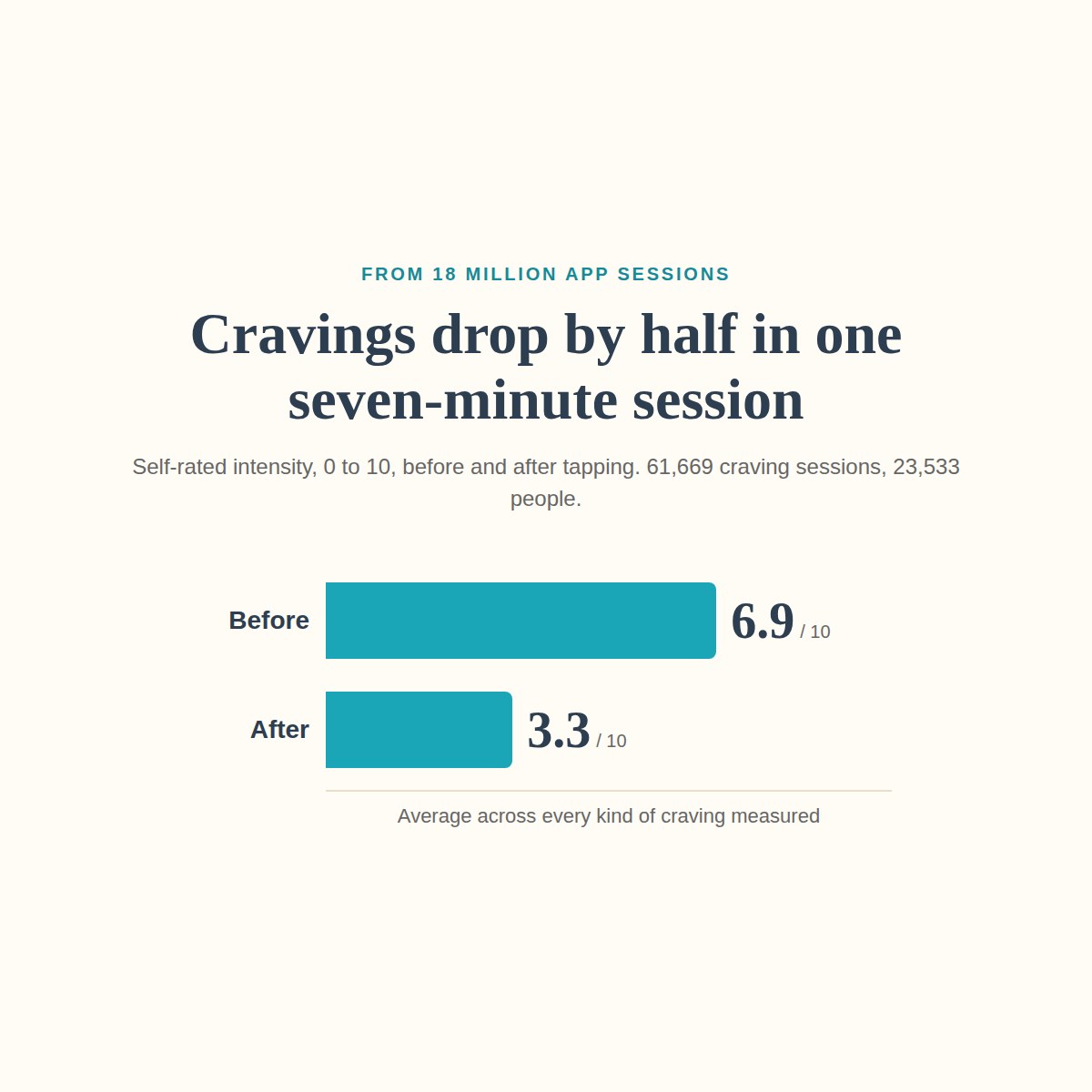
There are many, many reasons that I love Tapping, one of which is that it has the potential to help with conditions that are normally quite difficult to resolve using standard treatments.
A powerful example of that is addiction. Addiction is a very powerful thing, and a very challenging issue to treat. But for many years now, I’ve witnessed EFT Tapping help many people to break free from a variety of different addictions.
For a complete look at the evidence behind tapping, including the criticisms, see our full guide.
And there’s even research to back that up, suggesting that Tapping can be a very effective tool to implement when it comes to addiction treatment.
Today, I’ll shine the spotlight on the cravings research, because cravings are where addiction shows up moment to moment.
Researchers looked at the effect of Tapping on cravings

The strongest evidence on Tapping and cravings comes from two trials led by Dr. Peta Stapleton.
The first was a four-week EFT program for 96 overweight and obese adults. It reduced food cravings, and the improvements in body weight and BMI were still present a full 12 months later.[1]
The second tested whether Tapping could work just as well delivered entirely online. Ninety-six people completed an eight-week, self-paced EFT program, and food cravings dropped 28%. That benefit was still there at a two-year follow-up.[2]
Free. The best place to start.
Want to learn tapping from the people who know it best?
The Tapping World Summit has taught tapping to people all over the world since 2009. Ten days, 24 of the world's leading tapping teachers, 100% free.
Join the free summitWhy are these research findings important?
Together, these two studies show Tapping can reduce cravings, and that the reduction can hold up over the long term, a year later in the first study, two years later in the second.
The second study also matters for access. Not everyone can get to an in-person workshop or a therapist's office. A self-paced program people can do from home, at their own pace, and still see cravings drop and stay down, opens the door to a lot more people.
Cravings are one of the hardest parts of recovery to manage day to day. A tool that people can reach for in the moment, whenever a craving hits, fills a real gap in what's otherwise available.
Common, traditional treatments for addiction often don’t give people something to do in the moment a craving hits. But Tapping has the potential to do that. All of these things can support addiction treatment from a variety of angles and can support individuals in moving towards recovery.
Let’s dive a little bit deeper into the benefits of Tapping for addiction support.
The many ways in which Tapping can support addiction recovery
EFT Tapping isn’t a cure all, and recovery from severe addiction is a long process. But Tapping has, time and time again, helped people continue to progress towards recovery.
Here are some of the top reasons why Tapping can be such an effective tool for addiction support:
1. It helps to reduce stress
One reason Tapping can be so helpful for cravings and addiction is that it is proven to help disrupt the body’s stress response. Tapping prompts your body to release fewer stress hormones, which allows your body and mind to return to a calmer, more relaxed state.[3,4]
This is important, because stress and addiction are tightly linked. Excess use of alcohol, cigarettes, drugs, or even food is often a sign of too much stress.
Stress and cravings feed each other. The more stressed and less able to manage that stress a person is, the harder cravings tend to hit, and managing that stress response is one way to take some of the pressure off.
The relaxation response triggered by Tapping can help people struggling with addiction to respond to stressful situations from a place of greater balance and calm. And that has the potential to disrupt the harmful patterns and habits that people with addiction may otherwise commonly fall into.
One of the special things about Tapping is that it has the ability to calm stress and anxiety very quickly, making it an effective tool to turn to for fast relief!
2. It helps release unresolved emotional issues
Tapping is also an excellent tool for addressing unresolved emotional issues that can often play a role in substance use.
I’ve worked with many people around addictions and cravings using Tapping. With our Tapping work we usually start on the surface to address the physical craving, but then we almost always dig deeper to the feelings that are buried underneath whatever the substance of choice may be (whether it is alcohol, sweets, or cigarettes).
Through Tapping, we are able to find the unresolved emotional issues that are truly at the root of the problem. This allows the potential for long-term resolution of addictive behaviors, because we have actually gone underneath the surface to the deeper issues.
3. It provides a healthy behavior replacement
Tapping gives people struggling with addiction a new, healthier way to treat themselves and care for themselves on a day-to-day, moment-to-moment basis.
Whenever a craving hits, individuals can turn to the Tapping technique as a positive habit to take the place of their old behaviors.
For example, if someone who is trying to stop drinking alcohol is at a dinner party and finds themselves tempted to accept the offer of a glass of wine, they can excuse themselves briefly to do a few rounds of Tapping instead. Or if someone tends to always crave a cigarette on their lunch break to help them release stress, they can practice Tapping on that break instead as a healthier, and more effective, alternative.
Tapping is a great way to interrupt old patterns and rewire our habits toward more productive responses so that we can release the habits that have been causing harm.
Tapping resources for addiction and cravings
From smoking, to alcohol, to food, to drugs, Tapping can be an invaluable tool on the journey to recovery for a wide range of addictive substances.
If you or a loved one struggles with substance use, addiction, or cravings, I encourage you to turn to Tapping for added support. It is extremely effective and can provide quick relief, supporting long-term resolution and recovery.
I’ve seen Tapping help transform lives over and over again, leading to positive, lasting change.
If you are interested in giving it a try, you can learn more about Tapping and how to Tap on our Tapping 101 page.
And if you want to dive in further, try downloading The Tapping Solution App. In the app, you can find guided Tapping meditations specifically designed to support you with addictions and cravings.
Here are a few examples of topics covered in the app:
- Opioid Detox Support: Craving Relief
- Opioid Detox Support: Sleep Programming
- Overcome Cigarette Cravings & Quitting Smoking
- Cravings Buster: Alcohol
- Cravings Buster: General Cravings
- Cravings Buster: Sugar
Until next time…
Keep Tapping!
Nick Ortner
References
- Stapleton P, Sheldon T, Porter B. Clinical Benefits of Emotional Freedom Techniques on Food Cravings at 12-Months Follow-Up: A Randomized Controlled Trial. Energy Psychology Journal, 2012;4(1):13-24.
- Stapleton P, Lilley-Hale E, Mackintosh G, Sparenburg E. Online delivery of Emotional Freedom Techniques for food cravings: a randomized controlled trial with two-year follow-up. 2020.
- Church D, Yount G, Brooks AJ. The effect of emotional freedom techniques on stress biochemistry: a randomized controlled trial. J Nerv Ment Dis. 2012;200(10):891-896.
- Stapleton P, Crighton G, Sabot D, O’Neill HM. Reexamining the effect of emotional freedom techniques on stress biochemistry: A randomized controlled trial. Psychol Trauma. 2020;12(8):869-877.