Obsessive-Compulsive Disorder (OCD) can feel overwhelming, consuming your thoughts and leading to compulsive behaviors that interfere with daily life. While traditional therapies like Cognitive Behavioral Therapy (CBT) and medication can be helpful, many people with OCD are looking for additional tools to manage their symptoms and take their healing into their own hands. That’s where EFT Tapping comes in.
Tapping for OCD offers a complementary approach to help you manage the anxiety and distress that come with OCD. In this guide, we’ll explore how EFT Tapping works for OCD and provide step-by-step instructions to help you integrate this powerful tool into your management plan.
Note: Please consult with a doctor on any symptoms you are experiencing. The information and meditations referenced here are designed to support your healing, and aren’t a substitute for professional medical advice.
And if anxiety shows up in other corners of your life too, our complete guide to tapping through anxious moments has you covered.
What Tapping Can and Can't Do With OCD
OCD is a diagnosis, and the treatments with the strongest evidence behind them are ERP (exposure and response prevention) and CBT, sometimes alongside medication a doctor has prescribed. Tapping doesn't treat OCD and isn't a replacement for that care. What it can do is help with the anxiety and distress that show up around an intrusive thought or the urge to do a compulsion, in the moment, as one tool alongside your treatment plan.
| Tapping can help with | Tapping is not |
|---|---|
| The spike of anxiety when an intrusive thought shows up | A treatment for OCD itself |
| The urge to check, wash, or reassure yourself, in the moment | A replacement for ERP, CBT, or medication |
| General stress and overwhelm that make OCD symptoms harder to manage | A way to make an intrusive thought "go away" or prove it isn't true |
| Calming down enough to use the coping skills from therapy | Something to do instead of talking to a clinician |
If OCD is affecting your daily life, work with a therapist trained in ERP or CBT, and loop your doctor in on medication questions. Tapping fits in alongside that care, not in place of it.
How does Tapping for OCD work?
Tapping (also known as Emotional Freedom Techniques or EFT) is a powerful mind-body approach that has shown promising results for many individuals struggling with OCD symptoms.
A unique combination of acupressure, psychology, and neuroscience principles, EFT Tapping for OCD works to interrupt the cycle of obsessive thoughts and compulsive behaviors in several ways:
- Calms the nervous system: Tapping on acupoints sends calming signals to the amygdala, the brain's fear center. This helps reduce the anxiety and distress that fuel OCD.
- Rewires neural pathways: Tapping involves various strategies like reframing limiting beliefs, challenging unhelpful thoughts, visualization, neuro-linguistic programming, and more to create new, healthier neural connections in the brain.
- Provides an alternative coping strategy: Tapping gives you a concrete action to take when obsessive thoughts arise, providing a calming and healing alternative to compulsive behaviors.
- Addresses underlying emotions: Tapping allows you to safely process difficult emotions, memories, or experiences that may be at the root of OCD symptoms.
- Increases mindfulness: The Tapping sequence encourages present-moment awareness, helping break the spiral of anxious thoughts and bringing you back to the here and now.
Does Tapping for OCD really work?
Research on EFT for OCD is still emerging, but studies on EFT for stress and anxiety shows promising results.
For example, a 2019 study found that Tapping decreased anxiety levels by 40%.[1] In The Tapping Solution App, we’ve observed similar results, with users experiencing an average reduction in anxiety of 40% after completing our Releasing Anxiety session (just 9 minutes long).
Researchers have also found that just one hour of Tapping can decrease cortisol (the stress hormone) levels by 43%, helping our bodies calm, our minds settle, and our entire nervous system return to a relaxed state.[2]
Since OCD is an anxiety-based disorder, these findings are encouraging and provide hope for those looking to support their OCD symptoms through Tapping.
We’ve heard story after story of people finding relief and freedom from OCD with the help of Tapping. Here are just a few real-life examples:
“Hi!! After 15 years of debilitating health and OCD that kept me housebound for most of the time, I am now starting a part time job next week!! I've been tapping daily for about 2 years and this is the result!!” -Chris
“Tapping has helped me and it has also improved my mood and I've noticed I have been more compassionate and forgiving to myself. I have also noticed a significant improvement in my OCD.” -Dylan
I'm so happy, I had to share my success! I've had this terrible habit throughout most of my life since I was about 13 that try as I might, I've never been successful to break. It has spontaneously disappeared sometimes for a year or even two at a stretch, but then just as spontaneously started up again, and no matter how hard I try, I've never been able to consciously stop. In the past year, it's become stronger than ever. I've even been seeing a therapist to see if she could help me work through any stress or anxiety that might be underneath it (although I'm not aware of any particular emotion driving or triggering it). She introduced me to tapping. I've been tapping on it for the past 10 days, and yesterday, for the first time, I did not engage in the behaviour! Each time I caught myself starting or having the urge, I did some tapping (I think I tapped 3x on it yesterday).
Today the urge is strong again, and I've just tapped on it again. It's helped reduce the urge enough that I've stopped for now. I'll tap again when I need to. For the first time, I'm feeling hopeful that maybe I can finally break this habit!
AND, I also had a good day diet-wise yesterday too. Made healthy choices based on wanting to take care of myself and feel good in my body, more so than just to lose weight (I've been tapping on this too) -Audrey
Free. The best place to start.
Want to learn tapping from the people who know it best?
The Tapping World Summit has taught tapping to people all over the world since 2009. Ten days, 24 of the world's leading tapping teachers, 100% free.
Join the free summitStep-by-step EFT Tapping technique for OCD
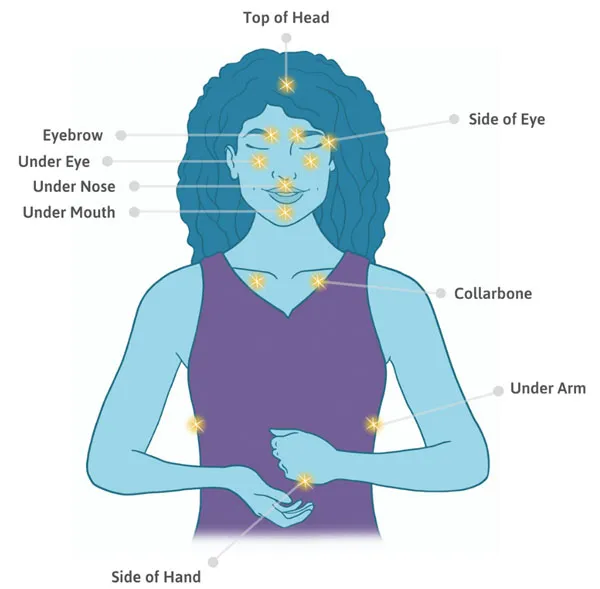
Here's how to use Tapping to manage OCD symptoms:
- Identify the specific obsession or compulsion you want to address. Rate its intensity from 0-10.
- Create a setup statement that acknowledges the issue while accepting yourself. For example: “Even though I have this urge to check the locks repeatedly, I deeply and completely accept myself.”
- Tap on the side of your hand while repeating your setup statement 3 times.
- Tap through the following points 5-7 times each while focusing on your OCD symptom:
- Eyebrow
- Side of the eye
- Under the eye
- Under the nose
- Under the mouth
- Collarbone
- Under the arm
- Top of the head
- Take a deep breath and reassess the intensity of your symptom. Repeat the process as needed until you feel relief.
New to Tapping? Want to learn the basics? Check out this comprehensive guide on how to do EFT Tapping.
EFT Tapping Script for OCD
Here's a basic Tapping script you can follow to address OCD symptoms:
Side of the hand:
“Even though I feel compelled to [specific compulsion], I accept myself and how I feel.”
“Even though this obsessive thought won't go away, I'm open to feeling calm and in control.”
“Even though OCD makes me anxious, I choose to be gentle with myself.”
Eyebrow: “This obsessive thought”
Side of the eye: “I just feel so anxious”
Under the eye: “The urge to [compulsion]”
Under the nose: “Part of me feels out of control”
Under the mouth: “I want to get out of this pattern”
Collarbone: “But I can’t seem to stop”
Under the arm: “I fear something bad will happen”
Eyebrow: “What if I could let this go?”
Side of the eye: “Maybe I'm safer than I think”
Under the eye: “I choose to breathe deeply now”
Under the nose: “I'm open to shifting this old pattern”
Under the mouth: “I am strong, flexible, and resilient”
Collarbone: “Letting go of the need to [compulsion]”
Under arm: “I am in control of my actions”
Top of head: “Feeling calmer and more relaxed now”
Tips for using EFT Tapping for OCD
- Start with less intense symptoms: Begin by Tapping on milder obsessions or compulsions to build confidence in the technique.
- Be specific: Target one thing at a time for best results, such as an intrusive thought or compulsion.
- Customize your statements: Use language that resonates with your specific OCD experiences for maximum effectiveness.
- Stay aware: As you tap, stay present with your physical sensations and emotions without judgment.
- Be persistent: OCD patterns often take time to shift. Regular Tapping, even when symptoms aren’t present, can help rewire the brain.
- Combine with other treatments: EFT is a great tool to put into your healing toolbox and can work well alongside therapy, medication, and other OCD management strategies.
- Seek professional guidance: An EFT practitioner experienced with OCD can help tailor the technique to your needs and support you on your healing journey.
A 3-Minute Round for the Urge to Check
The goal here isn't to resist the compulsion through willpower. It's to tap on the anxiety underneath it, so the urge has less charge behind it. Tap on the feeling, not on doing (or not doing) the compulsion.
- Rate the urge. Notice the pull to check, wash, or seek reassurance right now, and give it a 0-to-10 number.
- Side of hand, three times: "Even though I have this urge to check, I accept myself and how I feel."
- Side of hand: "Even though this anxiety wants me to act right now, I'm open to feeling calmer."
- Side of hand: "Even though part of me is sure something bad will happen if I don't, I choose to be gentle with myself."
- Eyebrow: "This urge to check"
- Side of eye: "This anxious feeling"
- Under eye: "My body wants certainty right now"
- Under nose: "Part of me is scared to sit with not knowing"
- Under mouth: "But I can feel this and not act on it"
- Collarbone: "Letting this anxiety settle, just a little"
- Under arm: "I can tolerate this uncertain feeling"
- Top of head: "Choosing to feel calmer right now"
Breathe, and check your number again. If it's dropped, that's the anxiety settling, which is the point: it leaves you more room to use the skills from your ERP or CBT work.
Reminder Phrases by Moment
Swap the reminder-phrase line in any round for one that matches what's actually happening.
| Moment | Reminder phrase to tap on |
|---|---|
| An intrusive thought | "This thought showed up, and it scares me" |
| The urge to check | "This pull to check, right now" |
| Contamination fear | "This feeling that something isn't clean" |
| The need for certainty | "This need to know for sure" |
| After a compulsion | "This shame about giving in" |
What Our Data Shows
There's no OCD-specific study or app session in our own data yet, so here's what we do have, offered as general anxiety data rather than an OCD outcome. Our Emotional Freedom category (58 sessions) shows an average drop from 7.0 to 4.1, a 42% drop in self-reported intensity, and our Calm Your Mind category (16 sessions, including "Help Me Stop Worrying") shows a 7.2 to 4.0 average drop, a 44% drop.
A 2020 study published in JMIR followed 270,461 users of a tapping app and found an average 44% drop in anxiety and 45% drop in stress after a single session (Church & Stapleton, 2020). None of this is OCD-specific research, but it's the honest picture of what tapping's own evidence base currently shows for the anxiety piece.
What People Say
Andrea, on OCD and chronic overthinking, going from a 10 to a 0: "Thank you for creating this perfect and helpful meditation! I will use this often because I have OCD and tend to overthink everything. I had a very bad day and was overwhelmed and overthinking everything and could not let go."
Julia, general anxiety feedback (not OCD-specific) on our "Help Me Stop Worrying" session, going from a 6 to a 3: "This is a game changer for my racing and anxious thoughts. I felt the relief immediately."
Getting started with Tapping for OCD
Many people with OCD find Tapping to be a valuable tool for managing symptoms and reducing overall anxiety. The beauty of Tapping is that it’s always available to you as a coping strategy, no matter where you are.
If you're interested in exploring EFT Tapping for OCD, anxiety, stress, or other concerns, The Tapping Solution App offers guided sessions specifically designed to support you through the process from start to finish. It’s like having a Tapping coach in your pocket 24/7.
Download the app for free today and see how it works for you.
- Instantly reduce anxiety and stress
- Fall asleep faster and sleep better
- Boost productivity, stay motivated
- Relieve chronic or occasional pain
- Release anger, find peace


Here are some of the sessions you can choose from that might help:
- CBT & Tapping: The Power of Combined Therapies
- Change Your Thinking Category
- Anxiety Relief: I Can’t Stop Worrying About Everything
- Micro Boost of Safety
- Instant Boost of Peace
- Release Overwhelm Quick Tap
For the basics of the technique, see Tapping 101 and the 9 tapping points chart, plus our full list of tapping phrases and tapping scripts for other situations. If intrusive thoughts specifically are the hardest part for you, our guide to tapping for intrusive thoughts goes deeper on that piece.
Remember, healing from OCD is a journey. Be patient and compassionate with yourself as you explore new ways to manage your symptoms.
If you want to understand why these thought loops form in the first place, my book REWIRED walks through the neuroscience behind them and how Tapping interrupts the pattern.
Until next time... Keep Tapping!
Nick Ortner
Frequently Asked Questions
Does tapping help OCD?
Tapping isn't a treatment for OCD itself. It's a self-help tool for the anxiety and distress that come with intrusive thoughts and urges, used alongside evidence-based care like ERP (exposure and response prevention) or CBT, and medication where a doctor has prescribed it. Used that way, many people find it helps them sit with distress without acting on a compulsion.
Can tapping replace ERP or medication?
No. OCD is a diagnosis treated by trained clinicians, usually with ERP or CBT and sometimes medication. Tapping is not a substitute for that care. Use it alongside your treatment plan, not instead of it, and talk to your therapist about how the two fit together.
How do I tap on intrusive thoughts?
Tap on the anxiety and distress the thought brings up, not on trying to make the thought itself go away or on the compulsion to check or fix it. Name the feeling ("this anxious feeling," "this urge to check"), rate it 0 to 10, and tap through the points on that feeling until it eases.
What do I say when tapping for OCD?
Start with something like "Even though I have this urge to check, I accept myself and how I feel," then tap through the points naming the anxiety, the urge, and the discomfort of not acting on it. Keep the language about your feelings, not about proving the thought is true or false.
Does tapping make the intrusive thoughts worse at first?
It's normal to notice a thought more, briefly, right as you start naming it and tapping on it. That's different from it getting worse. If the distress keeps climbing instead of settling after a few rounds, stop and reach out to a therapist or EFT practitioner rather than pushing through alone.
Where can I find a clinician for OCD?
The International OCD Foundation (iocdf.org) keeps a directory of therapists trained in ERP for OCD. Your doctor can also refer you to a CBT or ERP-trained therapist in your area. If you'd like to work with someone one-on-one on the tapping side, our practitioner directory lists independent EFT practitioners who work online and in person.
References
- Bach D, Groesbeck G, Stapleton P, Sims R, Blickheuser K, Church D. Clinical EFT (Emotional Freedom Techniques) Improves Multiple Physiological Markers of Health. J Evid Based Integr Med. 2019;24:2515690X18823691. doi:10.1177/2515690X18823691
- Stapleton P, Crighton G, Sabot D, O’Neill HM. Reexamining the effect of emotional freedom techniques on stress biochemistry: A randomized controlled trial. Psychol Trauma. 2020;12(8):869-877.


