
A thought shows up that you didn’t ask for, and it won’t leave. Maybe it’s a flash of something violent, a doubt about whether you locked the door, or a "what if" that loops before you can talk yourself out of it. It can be unsettling enough that you start wondering what it says about you. If that’s where you are right now, you’re not the only one. Unwanted thoughts, images, and doubts are one of the most common things people bring to Tapping.
Some unwanted thoughts are just that, a passing thought. For others, an intrusive thought shows up paired with a compulsion, a checking ritual, a washing routine, a mental review, and that pattern points toward OCD, a diagnosis treated by a clinician. Tapping works on the anxiety, shame, and urgency a thought brings up. It isn’t a treatment for OCD, and it doesn’t need to erase the thought to help you find relief and regain peace in your mind.
You'll find the whole process, scripts and all, in our full anxiety tapping guide.
What is Tapping for intrusive thoughts?
Intrusive thoughts are those unwanted thoughts, images, or urges that seemingly come from nowhere and cause significant distress. While everyone experiences occasional unwanted thoughts, they become problematic when they occur frequently, cause intense anxiety, or interfere with daily life.
Common types of intrusive thoughts include:
- Repeated worries about safety or harm
- Unwanted violent or aggressive images
- Persistent doubts or “what if” scenarios
- Fear of acting on unwanted impulses
- Obsessive thoughts about contamination or cleanliness
EFT (Emotional Freedom Techniques) Tapping offers a unique solution by combining ancient Chinese acupressure with modern psychology. The Tapping technique for intrusive thoughts involves gently tapping on specific acupressure points on your body while acknowledging and processing these specific thoughts.
This powerful technique helps by:
- Calming the amygdala (your brain's fear center) to reduce anxiety
- Breaking the cycle of obsessive thinking
- Decreasing the emotional charge of intrusive thoughts
- Promoting acceptance, self-compassion, and self-awareness.
- Creating new neural pathways for healthier, more empowering thought patterns
Step-by-step guide to Tapping for intrusive thoughts
If you are new to Tapping and want a breakdown of the basics, check out our comprehensive beginner’s guide to EFT Tapping. And if you are looking for specific Tapping techniques for OCD, go here.
When you’re ready to give it a try, here’s how to use EFT Tapping when intrusive thoughts arise:
Step 1: Rate Your Distress
Before starting, notice the intrusive thought that has been bothering you. How intense does the intrusive thought feel, on a scale from 0 to 10 (with 10 being it feels the most intense and powerful, and 0 being it doesn’t have any charge behind it at all).
Step 2: Tap on the Side of the Hand While Repeating a Setup Statement
While tapping on the Side of the Hand point, repeat a setup statement that acknowledges the thought, while also accepting yourself and how you feel.
Examples:
- “Even though I can't stop thinking [fill in the blank], I deeply and completely accept myself”
- “Even though this thought keeps running through my mind, I accept how I feel and I am safe to breathe in this moment”
- “Even though this thought feels so true in this moment, I acknowledge that it is just a thought, and I am open interrupting this pattern”
Step 3: Tap Through the Points
Moving through each of the points below in order, tap while expressing your feelings about the intrusive thoughts.
You can repeat “reminder phrases” to yourself while you tap through the points (like “These unwanted thoughts about [fill in the blank],” “I feel out of control, or “I wish these thoughts would stop”). Or, simply think about whatever is distressing you and reflect on how it makes you feel as you tap.
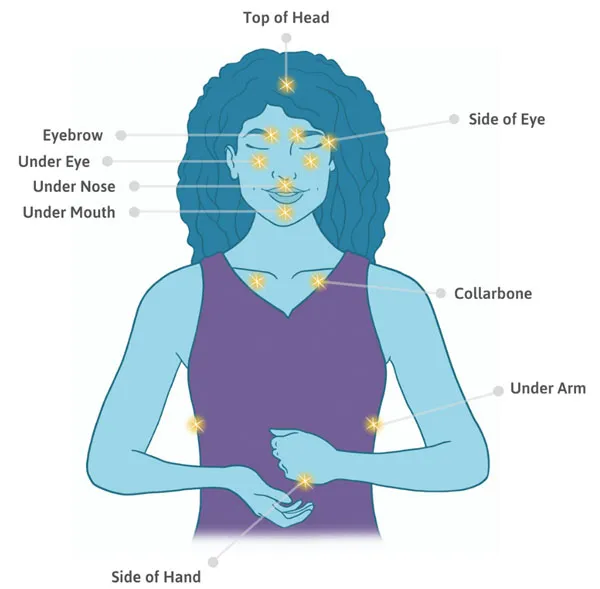
Tapping point sequence:
- Eyebrow
- Side of the Eye
- Under the Eye
- Under the Nose
- Under the Mouth
- Collarbone
- Under the Arm
- Top of the Head
Step 4: Move Toward the Positive
After a round or two focusing on the problem and releasing the charge of the thought, begin shifting toward more empowering statements as you continue tapping through the points in sequence.
As you release the charge of the unhelpful thought patterns, you can now rewire more positive, empowering thoughts in their place.
Some affirmations you may repeat as you tap could include:
- “I am more than my thoughts”
- “I can observe these thoughts without engaging with them”
- “I choose to remain calm”
- “These thoughts are just thoughts; they cannot harm me.”
- “I am safe and in control”
Step 5: Reassess How You Feel
Stop Tapping, and take a deep breath. Then, tune back into the strength of the original intrusive thought. How intense does it feel now, on the same 0 to 10 scale? If your number is still higher than you’d like and the thought still has more of a hold on you than you’d like, go back to the beginning and repeat the process, adjusting the words you use to fit how you feel now. Keep repeating until you feel a shift.
Struggling with intrusive thoughts about memories from the past and want to take your Tapping experience even deeper? Learn about a powerful technique called the Gamut Point Procedure here.
- Instantly reduce anxiety and stress
- Fall asleep faster and sleep better
- Boost productivity, stay motivated
- Relieve chronic or occasional pain
- Release anger, find peace


Free. The best place to start.
Want to learn tapping from the people who know it best?
The Tapping World Summit has taught tapping to people all over the world since 2009. Ten days, 24 of the world's leading tapping teachers, 100% free.
Join the free summitWhen to seek additional support when using Tapping for obsessive thoughts
While Tapping can be incredibly effective for managing intrusive thoughts, it’s important to note that persistent intrusive thoughts may be a sign of underlying conditions and may require professional support.
Always reach out to a qualified mental health professional when you are struggling and need support.
Many therapists now incorporate EFT Tapping into their treatment approaches, offering a powerful combination of professional support and effective self-help techniques.
Intrusive Thoughts and OCD: What’s the Difference
Intrusive thoughts and OCD are not the same thing. Almost everyone has an unwanted thought sometimes, a flash of doubt, a disturbing image, a "what if" that doesn't belong, and moves on. OCD pairs an intrusive thought with a compulsion: checking, washing, mentally reviewing, done to try to make the anxiety go away. If that's your pattern, our guide to tapping for OCD covers it, alongside a therapist trained in ERP (exposure and response prevention) or CBT.
Tapping isn't a treatment for OCD, and it doesn't work by proving a thought false. What it can do is take some of the charge off the thought, so it has less pull on you. If it's more a worry looping all night than a single thought, why your brain gets stuck on a thought covers that. One note on the setup statements below: they aren't built to argue with a thought or prove it isn't true, since fighting an intrusive thought makes it louder.
Types of Intrusive Thoughts and a Setup Statement for Each
If a harm-themed thought ever comes with a real urge to act on it, or with thoughts of harming yourself, stop and get help first: call or text 988 for the Suicide and Crisis Lifeline, or call 911 if someone is in immediate danger. Tapping can be a genuine support alongside that care, but it isn't a replacement for it.
| Type of intrusive thought | What it can sound like | Setup statement (acknowledge, not argue) |
|---|---|---|
| Harm-themed thought | An unwanted image of hurting someone you love, or yourself | "Even though this thought about harm scares me and isn't something I want, I accept myself and how frightening it feels." |
| Doubt loop | "What if I left the stove on," replayed over and over | "Even though this doubt keeps circling back, I accept myself and how unsettled it feels." |
| Contamination thought | A feeling that something isn't clean, even when you know it probably is | "Even though this thought feels so real right now, I accept myself and how uneasy it makes me." |
| Fear of losing control | Worry about blurting something out, or losing control in public | "Even though I'm scared of losing control, I accept myself and how vulnerable that feels." |
A Round for the Thought You Wish Would Stop
Pick the setup statement above that fits, and use it in place of the first line below. The goal is to take enough charge off the thought that it stops running the show, not to argue it away.
- Name it and rate it. Notice the thought that's here right now, without arguing with it, and give it a number from 0 to 10 for how loud it feels.
- Side of hand, three times: "Even though this thought showed up out of nowhere, I accept myself and how it makes me feel."
- Side of hand: "Even though I wish my mind hadn't gone there, I'm willing to let this feeling be here instead of pushing it away."
- Side of hand: "Even though a part of me is scared of what this thought means about me, I choose to be kind to myself right now."
- Eyebrow: "This thought that showed up uninvited"
- Side of eye: "I never asked for this one"
- Under eye: "This fear about what it says about me"
- Under nose: "I'm allowing this, not arguing with it"
- Under mouth: "A thought is not the same as a wish or a plan"
- Collarbone: "Some of this intensity easing off"
- Under arm: "I can hold this thought without it holding me"
- Top of head: "Feeling a little more steady, right now"
Breathe, and check your number again. That's the charge settling, not an argument won.
What Our Data Shows
There's no single app session built around "intrusive thoughts" by name. The closest real data: our Calm Your Mind category (16 sessions, 343,689 completions) averages a drop from 7.2 to 4.0, a 44% drop. Help Me Stop Worrying (112,302 completions) averages 7.0 to 4.0, and Help Me Trust My Decisions (20,876 completions) averages 6.9 to 3.8. A 2020 JMIR study of 270,461 app users found anxiety drop from 6.7 to 3.8 and stress from 6.9 to 3.8 after one session (Church & Stapleton, 2020), and a 2016 meta-analysis by Clond, pooling nearly 700 people across 14 studies, found a similarly large drop, clearly bigger than comparison groups (Evidence Atlas). None of this is intrusive-thought-specific. It's the closest picture we have.
What People Say
Claire, on our Help Me Stop Worrying session, going from a 10 to a 2: "I feel so much calmer now. It's really helping me with my health anxiety. You are my utter 'go to'. Thank you."
Bish, on the same session, going from an 8 to a 0: "This was just perfect for me, as with many at this difficult time I am worrying about lots of things but my partner is sick and his care is consuming and that is consuming my thoughts, I know now that I don't have to worry about things to make sure that they get done."
Ready to start Tapping away intrusive thoughts?
Tapping for obsessive thoughts is a powerful way to help you break free from the thought patterns that hold you back, so you can feel more free and find more peace in your daily life.
The Tapping Solution App offers guided Tapping meditations specifically designed to help with intrusive and obsessive thoughts. Some relevant sessions include:
- Help Me Stop Overthinking
- Change Unhelpful Thought Patterns
- Quiet My Racing Mind
- Stop a Panic Attack
- Help Me Stop Assuming the Worst
- Quieting the Critical Voice
- I Am More Than My thoughts
Download The Tapping Solution App today to access these and hundreds of other guided Tapping meditations.
Remember, while intrusive thoughts can feel overwhelming, you’re not alone and you’re not powerless.
With consistent practice of the Tapping technique for intrusive thoughts, many people find significant relief and develop a healthier relationship with their thoughts over time.
If you want to understand why these loops take hold in the first place, my book REWIRED gets into the neuroscience of it and how Tapping helps rewire the pattern.
Until next time... Keep Tapping!
Nick Ortner
Frequently Asked Questions
What is Tapping for intrusive thoughts?
Intrusive thoughts are those unwanted thoughts, images, or urges that seemingly come from nowhere and cause significant distress. While everyone experiences occasional unwanted thoughts, they become problematic when they occur frequently, cause intense anxiety, or interfere with daily life.
Are intrusive thoughts the same as OCD?
Not always. Almost everyone has an unwanted thought sometimes without it becoming OCD. OCD is a diagnosis where an intrusive thought is paired with a compulsion, like checking, washing, or mentally reviewing, done to reduce the anxiety. If that's your pattern, talk with a therapist trained in ERP or CBT.
Can Tapping stop intrusive thoughts completely or cure OCD?
No. Tapping isn't a treatment for OCD, and it isn't a way to erase a thought or prove it false. It can reduce the anxiety, shame, and urgency around the thought, alongside care from a doctor or therapist when OCD is part of the picture.
What do I say when I tap on an intrusive thought?
Name the thought and how it makes you feel, without arguing that it's untrue. Something like, "Even though I'm having this thought and it scares me, I accept myself and how I feel," tapped through each point, works better than trying to talk yourself out of it.
When should I talk to a professional instead of tapping on my own?
If intrusive thoughts come with compulsions, checking, washing, or reassurance-seeking, bring it to a therapist trained in ERP or CBT, the care with the strongest evidence for OCD. If a thought ever comes with a real urge to act on it, or with thoughts of harming yourself, stop and get help right away: call or text 988 for the Suicide and Crisis Lifeline, or call 911 if someone is in immediate danger.
Where can I find a guided Tapping session for anxious or overthinking thoughts?
The Tapping Solution App's Calm Your Mind and Help Me Stop collections have sessions built for this, including Help Me Stop Worrying and Help Me Trust My Decisions. Download the app free and try one in about ten minutes.


