What if the benefits of face tapping could include both skincare advantages and emotional balance in one go, helping you both look good and feel good at the same time?
When most people think of facial tapping, they might imagine just another skincare fad to add to their beauty routine to improve skin tone or reduce wrinkles. But you don’t just want to look good, you want to feel good, too. And the simple act of tapping on certain points on your face can lead to benefits that go beyond skin deep, helping you glow from the inside out.
Face tapping is part of a technique called Tapping (also known as EFT Tapping, or Emotional Freedom Techniques), which involves tapping certain points on your face, hands, and body with your fingertips.
In this comprehensive guide, we'll explore the numerous benefits of face tapping and learn the basic EFT Tapping technique.
For the full story on how EFT tapping works, our in-depth guide is the best place to start.
Two Kinds of Face Tapping (And Which One This Guide Covers)
If you searched for face tapping, there's a good chance you were looking for a beauty routine, and that's not quite what the rest of this article covers. There are really two different things people mean when they say face tapping, and it helps to know which one you found.
The first is a beauty and skincare technique, sometimes done with your fingers and sometimes with a vibrating tool, where you tap along your cheeks, forehead, and jawline to boost circulation and support lymphatic drainage. People who do this report a brighter, less puffy look. We're not skin care experts, so we won't make claims here about what it does for your skin. That's a separate practice from what we teach.
The second is EFT Tapping (Emotional Freedom Techniques), which is what this article is about. It uses five of the nine EFT tapping points that happen to be on your face, tapped in a specific order while you focus on a feeling or a stressful thought, to calm your nervous system. It's not a skincare routine. It's a stress relief tool that happens to use your face as part of a bigger sequence that also includes your hand, collarbone, and underarm.
| Beauty/Lymphatic Face Tapping | EFT Face Tapping | |
|---|---|---|
| What it is | Tapping or vibrating along cheeks, forehead, and jaw to boost circulation | Tapping 5 acupressure points on the face as part of the 9-point EFT sequence |
| What people use it for | A brighter look, less puffiness, a skincare habit | Calming stress, anxiety, and difficult emotions |
| How long | Often a few minutes, done as part of a skincare routine | A few minutes per round, repeated until you feel calmer |
| Where to learn more | Skincare and beauty guides | The rest of this article, plus our tapping points chart |
If you came here for the skincare version, that's a fine thing to try, we just don't want to give advice outside what we actually know. If you're curious about the emotional and nervous system side of tapping your face, keep reading. That's exactly what we cover below.
The Surprising Benefits of Facial Tapping
Tapping has gained widespread recognition in recent years as an effective tool for boosting emotional and mental wellness. This technique combines the principles of ancient Chinese acupressure and modern psychology, offering a wealth of powerful (and surprising) benefits for body, mind, and spirit that include stress reduction, improved sleep, pain relief, and more.
Here are some of the key benefits you can expect from incorporating facial tapping into your daily routine:
#1. Stress Reduction
Tapping directly targets the amygdala, the part of your brain that's like the alarm system for stress, fear, and all kinds of emotional responses. When you tap on specific acupressure points during Tapping, you're essentially calming down and ‘turning off' this alarm system. The process sends calming signals to the amygdala, rewiring how we respond to the stressors and challenges of daily life.
When we're stressed, our brain acts like it's in danger. Tapping helps remind our brain that everything is okay and it can relax.
To give you an idea of how effective this can be, just one hour of EFT Tapping has been shown to reduce cortisol, the stress hormone, by 43%.[1]
#2. Anxiety Relief
Tapping can lower anxiety levels by disrupting negative thought patterns, calming the fight-or-flight response, and promoting a more balanced emotional state.
In The Tapping Solution App, users of the guided Releasing Anxiety Tapping meditation report an average reduction in anxiety of 40% after just 9 minutes.
#3. Better Sleep
By reducing stress and promoting relaxation, tapping on acupressure points on your face and other parts of your body can help you settle in, wind down, and fall asleep with greater ease.
People often report falling asleep faster, staying asleep longer, and finding relief from sleep issues like insomnia.
#4. Pain Relief
Tapping through the points on the face and rest of the body can help alleviate pain. EFT Tapping works quite well for pain relief because pain is often tied to stress or unresolved emotional issues. Through Tapping, you can release stress from your body and work through emotions that may be held in your body, helping to put your body into a relaxing and healing state.
In one study, participants’ pain levels decreased by 57% after just a 4-day workshop in EFT Tapping.[2]
#5. Improved Mental Wellbeing and Emotional Resilience
Facial tapping can help you process and release difficult emotions more effectively, leading to greater emotional resilience and mental wellbeing. This is a powerful tool that can help you navigate the demands and stressors of daily life with greater balance and ease.
With a large body of peer-reviewed research on EFT Tapping, including nearly 100 randomized controlled trials, we now know it can be effective to help people improve mental wellbeing and work through conditions like anxiety and depression.[3,4]
#6. Soothed Stomach
Tapping on your face, particularly on the acupressure point under the eye, can help settle your stomach and ease digestion. This point corresponds to the stomach meridian in traditional Chinese medicine, and tapping that point on your face may help when your stomach is feeling unsettled or uneasy.
#7. Increased Energy and Focus
As you release stress and help your nervous system feel safe, you’ll give your brain and body a break from working so hard. With the extra resources you get back, you’ll be able to experience greater energy, focus, and clarity, leaving you feeling more vibrant and alert.
#8. Improved Markers of Health
Tapping actually works on a physiological level to create changes in both the brain and body, leading to improved markers of physical health.
Studies suggest Tapping can impact physiological markers of health, such as cortisol levels, heart rate, blood pressure, and more. It’s even been suggested to positively influence gene expression and brain activity.[1,2,5,7]
While some people may experience skin-related benefits from facial tapping like improved circulation and a healthy glow (not surprising, since stress reduction is a great “anti-aging” approach!), as you now know the practice of Tapping is about so much more than that.
It’s about rewiring your brain, regulating your nervous system, managing your emotions, and setting yourself up to feel more calm, cool, and collected no matter what life throws your way.
Free. The best place to start.
Want to learn tapping from the people who know it best?
The Tapping World Summit has taught tapping to people all over the world since 2009. Ten days, 24 of the world's leading tapping teachers, 100% free.
Join the free summitHow to Do Facial Tapping: A Step-by-Step Guide
Now that we understand the benefits, let's explore the proper technique for Tapping.
Getting familiar with the 9 Tapping points
Tapping involves nine acupressure points, called Tapping points. They are found along the meridians used in traditional Chinese medicine.
Most of the Tapping points are found on the face (6 out of 9 are on the face and head!), while the other three are found on the side of your hand, your collarbone, and under your arm.
Many meridians either start or end on the face, making it a key area for this practice. That’s why during Tapping, you spend so much time tapping on your face.
To do the Tapping technique, you’ll use your fingertips to gently tap on each of the nine points in order, as you think about what is bothering you and repeat certain statements.
Here’s a handy diagram to show you where each of the 9 Tapping points are located on the face and body:
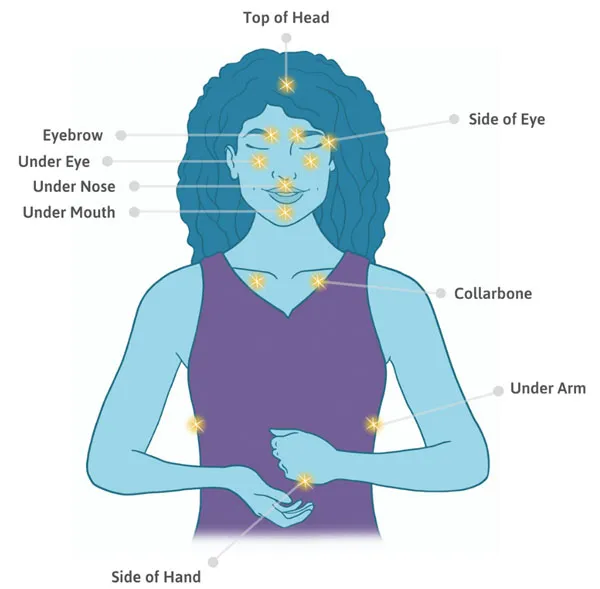
1. Side of the Hand (Karate Chop): This is the fleshy, narrow side of the hand on the side of the pinky finger.
Why we use it:
Releases feeling stuck and promotes ease in moving on, letting go, healing from grief, and becoming happy in the present moment.
2. Eyebrow, On the brow bone where the eyebrows begin, closest to the bridge of the nose.
Why we use it:
Releases trauma, hurt, and sadness and promotes peace and emotional healing.
3. Side of the Eye, On the bone directly along the outside of either eye.
Why we use it:
Releases resentment and anger and promotes clarity and compassion.
4. Under the Eye, On the bone directly underneath either eye.
Why we use it:
Releases fear and anxiety and promotes feelings of contentment, calmness, and safety.
5. Under the Nose, The area directly beneath the nose and above the upper lip.
Why we use it:
Releases shame and powerlessness and promotes self-acceptance, self-empowerment, and compassion for self and others.
6. Under the Mouth, This is the area just below your bottom lip and above the chin, right in the crease.
Why we use it:
Releases confusion and uncertainty and promotes clarity, certainty, confidence, and self-acceptance.
7. Collarbone, Starting from where your collar bones meet in the center, go down an inch and out an inch on either side.
Why we use it:
Releases the feeling of being stuck, promotes ease in moving on, and boosts confidence and clarity.
8. Under the Arm, On your side, about four inches beneath the armpit.
Why we use it:
Releases guilt, worry, and obsessing and promotes clarity, confidence, relaxation, and compassion for self and others.
9. Top of the Head, Directly on the crown of your head.
Why we use it:
Opens the crown chakra and promotes spiritual connection, while anchoring in the new balance and alignment from the tapping round that has just been completed.
Even just a few minutes of Tapping through the points each day can lead to significant improvements in your mental, emotional, and physical well-being over time.
Curious to learn more about each point? Check out this guide to the 9 main Tapping points.
How to do the Basic Tapping Sequence
You can try Tapping yourself by following these easy steps:
Step 1. Identify the issue you want to focus on and rate how you feel.
This might be a specific situation that you are stressed about, a physical symptom, or an emotion like anxiety or fear, for example. Ask yourself, “What is on my mind? What am I stressed or bothered about? What is my most pressing issue right now?” Anything causing your stress or discomfort can be the focus of your Tapping session.
Step 2: Rate how you feel
When you think about your stress, your discomfort, or the emotion, how intense is it right now? Rate how you feel right now on a scale from 0 to 10, with 0 being the lowest intensity and 10 being the highest. So if you are very stressed, you’ll be a 10 and if you are feeling completely at ease you’ll be a 0.
Step 3: Compose a “setup statement”
Tapping often begins with something called a “setup statement.” This statement acknowledges the problem you want to deal with. It should focus on accepting how you feel right now.
A setup statement often follows a framework that sounds something like this:
“Even though I [fill in the blank with your specific problem or feeling], I accept how I feel.”
An example might be, “Even though I’m anxious about my meeting at work, I accept how I feel.”
Step 4: Repeat the setup statement three times while Tapping on the side of the hand
Take a deep breath in, and then out. It’s time to start Tapping!
Gently tap your fingertips on the Side of the Hand. Continue Tapping here as you repeat your setup statement (either out loud or in your mind) three times over.
Step 5: Tap through the rest of the points
Next, it’s time to move through the remaining eight Tapping points starting at the Eyebrow and ending at the Top of the Head, in the following order:
- Eyebrow
- Side of the Eye
- Under the Eye
- Under the Nose
- Under the Mouth
- Collarbone
- Under the Arm
- Top of the Head
Tap gently with your fingertips for a few moments on each point before moving on to the next. As you tap on the points, simply say how you feel, either in your mind or out loud. Be honest with what is going on for you and how you are feeling about it. This process lets you release the emotion or discomfort as you go along.
You can repeat this entire sequence as many times as you’d like, until the intensity of your feelings have decreased and you are feeling more comfortable.
Step 6: Move towards the positive with one final round of Tapping
Now that you’ve released some of the intensity and you are feeling more balanced and at ease around the issue, you can begin to say empowering, uplifting statements to help you end on a powerful note.
Examples of empowering, positive statements to end with could include:
- “I am safe.”
- “I’ve got this.”
- “I am strong and capable.”
- “I am feeling calm and confident.”
- “All is well.”
Repeat these positive statements to yourself in your mind or out loud as you go through the Tapping points one more time.
Step 7: Rate how you feel again
After you finish Tapping, take a deep breath in and out, and then notice how you feel. How intense are your feelings now on the 0 to 10 scale? If you are feeling better, your new number will be lower.
For an in-depth explanation of the technique with extra tips and tricks, check out this comprehensive guide.
And if you truly want to experience the full benefits of facial tapping, incorporate this EFT Tapping into your daily routine. Following along to our short and easy guided sessions in The Tapping Solution App makes the process super easy and can help you build a regular habit.
The app has hundreds of options to choose from, with topics to suit every issue or need. You can start your day with a short Tapping meditation to set a positive tone, use it during stressful moments for quick relief, or end your day with Tapping to promote relaxation and better sleep.
As with any new practice, it's important to approach this practice with an open mind and give yourself time to experience its effects.
Download The Tapping Solution App today to access hundreds of guided Tapping meditations available anytime you need, right in your pocket (and it’s free to get started!)
- Instantly reduce anxiety and stress
- Fall asleep faster and sleep better
- Boost productivity, stay motivated
- Relieve chronic or occasional pain
- Release anger, find peace


Until next time… Keep Tapping!
Nick Ortner
The 5 Face Points in EFT and What Each Is For
Five of the nine EFT Tapping points are on your face. Here's a quick reference for each one and what it's typically used for, pulled from the full walkthrough above.
| Point | Location | What People Tap It For |
|---|---|---|
| Eyebrow | Brow bone, closest to the bridge of the nose | Trauma, hurt, and sadness |
| Side of the Eye | Bone along the outside of either eye | Resentment and anger |
| Under the Eye | Bone directly underneath either eye | Fear and anxiety |
| Under the Nose | Between the nose and upper lip | Shame and powerlessness |
| Under the Mouth | Crease between the bottom lip and chin | Confusion and uncertainty |
These five points are also where the phrases you say while tapping matter most. If you want ready-to-use language for each point, our guide to EFT tapping phrases has examples for common situations.
A 1-Minute Face-Only Tapping Round
The full EFT sequence includes your hand, collarbone, and underarm along with your face. But if you only have a minute, you can run through just the 5 face points as a quick reset.
- Take a breath in and out, and notice how you feel right now.
- Tap the Eyebrow point 5 to 7 times while naming what's bothering you.
- Move to the Side of the Eye and tap 5 to 7 times.
- Tap Under the Eye 5 to 7 times.
- Tap Under the Nose 5 to 7 times.
- Finish at Under the Mouth, tapping 5 to 7 times.
- Take another breath and check in again. Repeat the round if you want to keep going.
This isn't a replacement for the full 9-point sequence, it's a fast option for moments when you need something quick. For the complete routine with the hand, collarbone, and underarm points, use the step-by-step guide above, or for a calming round with extra support, our vagus nerve tapping guide walks through it in more detail.
What Our Data Shows
We don't just talk about Tapping helping people feel calmer, we track it. Inside The Tapping Solution App, people rate how they feel from 0 to 10 before and after every session, and we've looked at that data across more than 18 million sessions.
A peer-reviewed study of 270,461 App users, published in JMIR mHealth and uHealth (Church & Stapleton, 2020), found that anxiety dropped by 44% and stress dropped by 45% in a single session.
If you want to see what that feels like for yourself, you can try a free tapping session that includes tapping through the face points.
Frequently Asked Questions
What are the benefits of face tapping?
It depends which face tapping you mean. The beauty version is used for a brighter look and less puffiness. The EFT version, which is what this article covers, is used to calm stress and anxiety, ease difficult emotions, and help you feel more settled. In our App data across more than 18 million sessions, people rate their anxiety and stress lower after a single round.
Is face tapping good for your skin?
That's the lymphatic or beauty version of face tapping, not what we teach here. EFT face tapping is a stress relief technique, and we don't make claims about skin benefits. If skincare is what you're after, look at guides focused on that specific practice.
How many times a day should you do face tapping?
There's no fixed number. Some people do a short round once a day, others tap whenever stress comes up during the day. Start with once a day and add more rounds when you need them.
Can you just tap on your face without the other points?
Yes, you can tap just the 5 face points as a quick option, like the 1-minute round above. The full 9-point sequence, which includes your hand, collarbone, and underarm, tends to go deeper, so use the face-only version when you're short on time and the full sequence when you can.
Does face tapping help with anxiety?
Yes. In a peer-reviewed study of 270,461 users of The Tapping Solution App (Church & Stapleton, 2020, JMIR mHealth and uHealth), anxiety dropped by 44% in a single session. If you want to try it, our guide to tapping for anxiety relief walks through it in more depth.
Which finger should you use and how hard should you tap?
Use two or three fingertips, whichever feels natural, and tap gently. You're not trying to hit the point hard, just make contact with a light, steady tap while you focus on how you feel.
References
- Stapleton P, Crighton G, Sabot D, O’Neill HM. Reexamining the effect of emotional freedom techniques on stress biochemistry: A randomized controlled trial. Psychol Trauma. 2020;12(8):869-877.
- Bach D, Groesbeck G, Stapleton P, Sims R, Blickheuser K, Church D. Clinical EFT (Emotional Freedom Techniques) Improves Multiple Physiological Markers of Health. J Evid Based Integr Med. 2019;24:2515690X18823691.
- Clond M. Emotional Freedom Techniques for Anxiety: A Systematic Review With Meta-analysis. J Nerv Ment Dis. 2016;204(5):388-395.
- Nelms JA, Castel L. A Systematic Review and Meta-Analysis of Randomized and Nonrandomized Trials of Clinical Emotional Freedom Techniques (EFT) for the Treatment of Depression. Explore (NY). 2016;12(6):416-426.
- Maharaj, ME. Differential Gene Expression after Emotional Freedom Techniques (EFT) Treatment: A Novel Pilot Protocol for Salivary mRNA Assessment. Energy Psychology Journal. 2016;8(1):17-32.
Stapleton P, Buchanan C, Mitchell I, McGrath Y, Gorton P, Carter B. An initial investigation of neural changes in overweight adults with food cravings after emotional freedom techniques. OBM Integrative and Complementary. 2019;4(14):10-21926.