You’ve probably heard about the calming effects of Tapping, but did you know that it actually changes your brain?
For the last two decades, researchers have been trying to answer a harder question: what is Tapping actually doing inside your head while you calm down? The newest mechanism research gives us a clearer answer than we've had before.
Our full guide to the science behind tapping covers the meta-analyses, the cortisol data, and the fair critiques.
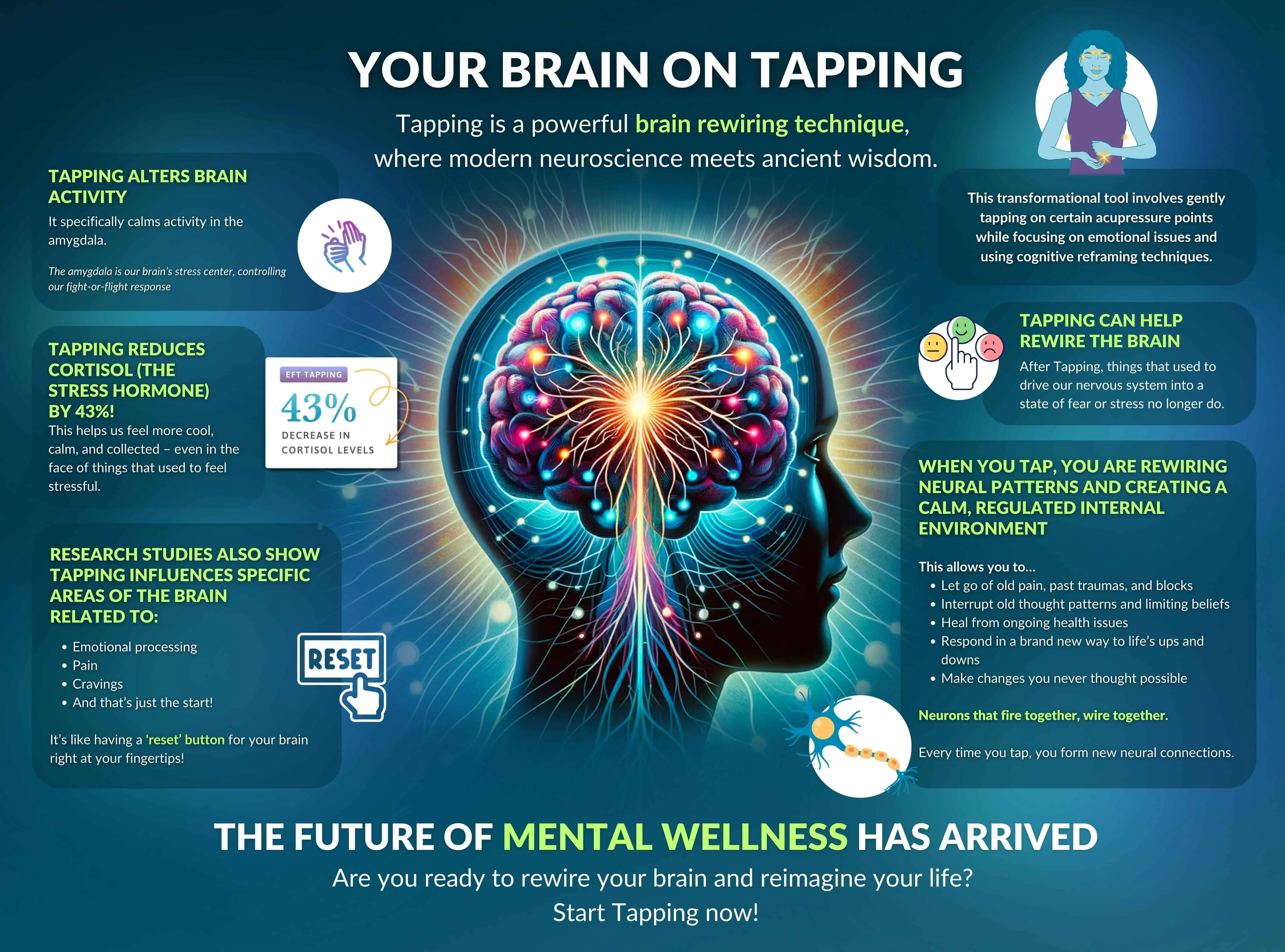
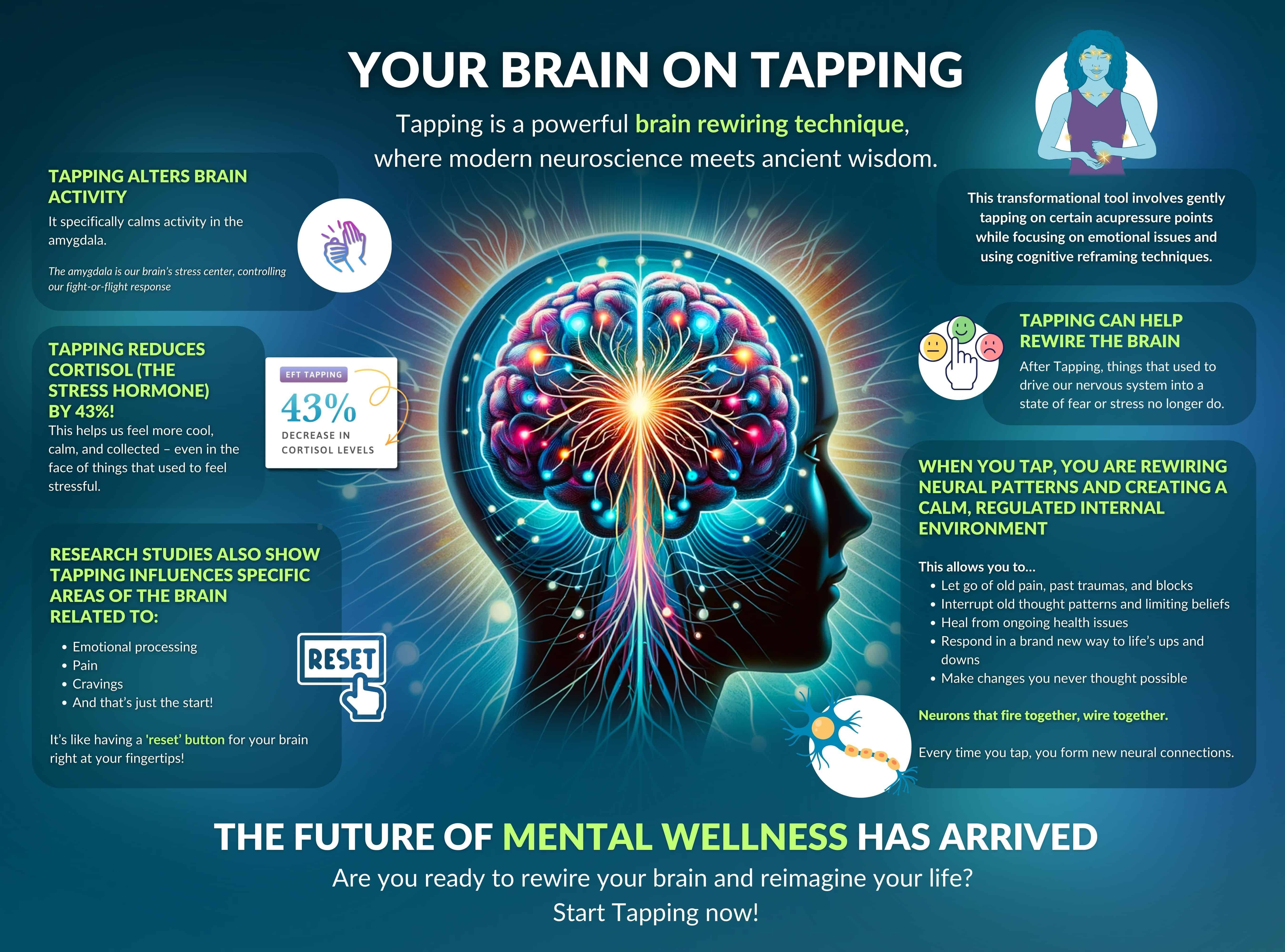
Just check out the infographic below to learn all about what's going on deep within your brain when you tap.
If you're wondering whether these brain effects depend on tapping the exact acupressure points, or whether any tapping-like motion would do, our broader research overview looks directly at that question.
What happens in the brain when you tap
The short version: tapping combines physical pressure on specific points with focused attention on whatever's bothering you, and that pairing appears to send your brain's threat-detection center, the amygdala, a signal that it's safe to stand down. That's the leading explanation in the research, and it isn't settled yet. Here's what the studies actually found.
The most complete synthesis is Feinstein (2025), a theory paper in Energy Psychology: Theory, Research, and Treatment that pulls together over 200 published clinical trials to propose a step-by-step chain: tapping generates a signal, that signal reaches the brain alongside the thought or memory you're focused on, and the combination appears to help update an outdated emotional response. This is a synthesis of existing research explaining the how, not a new trial adding fresh outcome numbers of its own.
On the biochemistry side, Church, Yount & Brooks (2012) ran a randomized controlled trial with 83 ordinary adults, not selected for any diagnosis. One hour-long tapping session, a supportive talking session, or nothing at all, then researchers measured the stress hormone cortisol in saliva before and after. The tapping group's cortisol, anxiety, and depression scores all dropped more than in the other two groups. It was a single short session in a general, non-clinical sample, showing an immediate biological response rather than a lasting clinical treatment effect.
A newer paper, Schwarz & Stapleton (2026), lays out a roadmap for why tapping works: six specific working parts (including the tapping itself and the gradual way distressing memories are approached) connected to four ways lasting change happens, including the updating of old distressing memories. It's a framework for future research, not a new trial.
There's also a gene-expression angle. Feinstein & Church (2010) proposed that adding physical techniques like acupoint tapping to psychotherapy might more precisely shift the gene-expression changes that go along with successful treatment, compared to talk therapy alone. That paper presents testable ideas for future research rather than new experimental data of its own, so treat it as a hypothesis, not a finding.
And on the brain-imaging side, Stapleton and colleagues (2019) scanned the brains of 15 overweight adults doing four weeks of group tapping or nothing, while showing them pictures of tempting food. The tapping group's cravings dropped more than three times as much as the control group's, and their brain scans showed calmer activity in the regions that light up around food temptation. It's a small pilot study, so that imaging finding needs replication in a larger sample before we call it settled.
One more piece worth including, because it's the closest thing to a placebo test this field has: Rogers & Sears (2015) randomly split stressed university students into two groups, one tapping on real acupressure points, the other tapping on points that aren't part of the meridian system. Both groups did the exact same ritual; only the tap locations differed. The real-tapping group's stress dropped about 39%, versus about 8% for the sham group, a difference unlikely to be chance. That points to the specific points mattering for a page about mechanism like this one, not just the act of tapping.
| Study | Design | N | What it found |
|---|---|---|---|
| Feinstein (2025), Physiological mechanisms of energy psychology: An updated synthesis | Theory synthesis of 200+ published trials, not a new trial | N/A (synthesis) | Proposes the step-by-step chain from a tapping signal to a calmer, updated emotional response |
| Church, Yount & Brooks (2012) | Randomized controlled trial, 3 arms | 83 | Cortisol, anxiety, and depression all dropped more after one hour of tapping than after talk therapy or nothing; a single-session, non-clinical result |
| Schwarz & Stapleton (2026) | Theoretical/clinical framework paper | N/A (framework) | Names 6 active ingredients and 4 mechanisms of change, including memory reconsolidation; a roadmap for future research |
| Feinstein & Church (2010) | Theoretical paper, testable propositions | N/A (theory) | Proposes that somatic techniques like tapping may more precisely shift gene-expression changes than talk therapy alone |
| Stapleton et al. (2019) | Small pilot, fMRI, group EFT vs. no treatment | 15 | Cravings dropped 3x more with tapping; calmer activity on brain scans in craving-related regions; needs replication |
| Rogers & Sears (2015) | RCT, dismantling design (real points vs. sham points) | 56 | Stress dropped 39% with real points vs. 8% with sham points, pointing to the specific points mattering |
Several of these are theory or synthesis papers, not new outcome trials, and that distinction matters more than a punchy headline. The fMRI craving study is a small pilot pointing in a direction, well short of proof of a fully settled mechanism. For the full picture on what the broader research base does and doesn't show, see our complete evidence guide.
Free. The best place to start.
Want to learn tapping from the people who know it best?
The Tapping World Summit has taught tapping to people all over the world since 2009. Ten days, 24 of the world's leading tapping teachers, 100% free.
Join the free summitA round for when your brain is stuck in a stress response
Here's a short round you can use the next time you notice your body reacting to something before your thinking mind has caught up. Rate the intensity of what you're feeling from 0 to 10 before you begin.
- Side of the Hand (1st time): "Even though my body is stuck in this stress response right now, I accept myself anyway."
- Side of the Hand (2nd time): "Even though part of my brain thinks this is an emergency, I accept how I feel."
- Side of the Hand (3rd time): "Even though I'm reacting to this like a threat, I choose to accept myself right now."
- Eyebrow: "This stress response."
- Side of the Eye: "My brain thinks I'm in danger."
- Under the Eye: "This tightness in my body."
- Under the Nose: "I don't have to fix this right this second."
- Under the Mouth: "It's safe for me to slow down."
- Collarbone: "Sending my brain the signal that I'm okay."
- Under the Arm: "I can let this settle a little."
- Top of the Head: "I am safe right now, in this moment."
Take a breath and check your number again. This is the same signal-plus-focus pairing the mechanism research above is describing, just in practice instead of on paper.
What our data shows
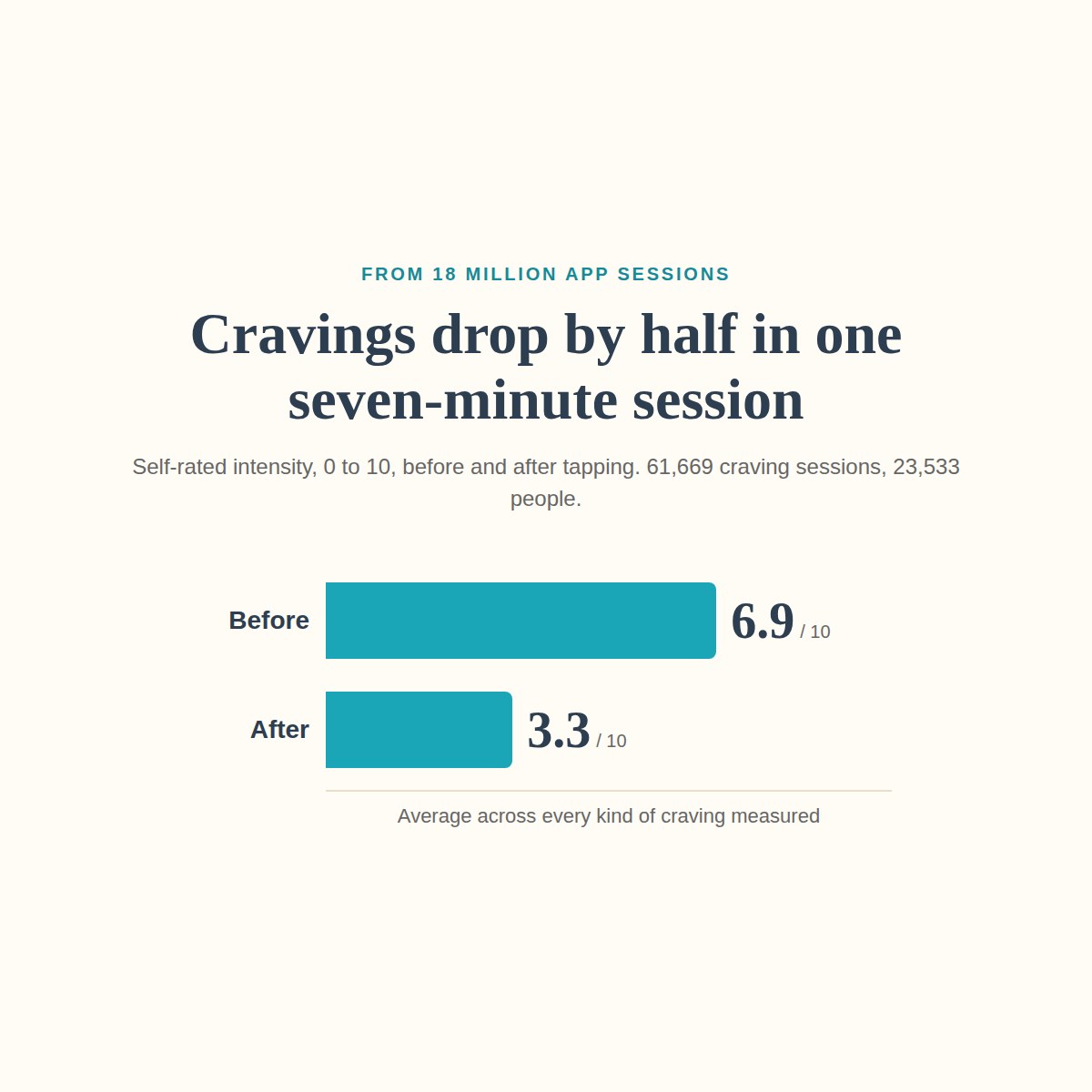
Nervous Tension and Stress Release is the closest match in the app to what the research above is describing, built around that exact stress-response pattern. It has been completed 195,670 times, with the average intensity rating going from 6.7 to 3.9, a 41% drop, in a single session. Across our broader Support Your Body category (104 sessions), people have completed 1,745,168 sessions with ratings dropping from 6.5 to 3.8, a 41% drop. And in the peer-reviewed JMIR study of 270,461 Tapping Solution App users, self-rated anxiety dropped 44% and stress dropped 45% after a guided session (Church & Stapleton, 2020, JMIR mHealth and uHealth).
This is self-reported, in-the-moment app data, not a controlled clinical trial. But at this scale, it's one of the largest tapping-and-outcomes datasets that exists anywhere, and it points the same direction as the mechanism research above.
What people say
"Wow, first time tapping ever. Just before bed, the nervous system tension left my body, and I discovered the root of it. So simple, so good. Thank you."
Heather, Nervous Tension and Stress Release, rated her tension a 10 before this session, a 1 after
"Your timing in my life at this moment is a miracle."
Christina, Instant Boost of Happiness, rated how she felt a 10 before the session, a 0 after
Go deeper
- Does Tapping Really Work? Research Says Yes!
- Nervous System Dysregulation: 12 Signs and How to Recover
- Vagus Nerve Tapping
- Tapping 101: What Is EFT Tapping?
- EFT Tapping Chart: Getting to Know the 9 Tapping Points
Your Brain on Tapping: Questions, Answered
How does tapping actually rewire the brain?
The leading explanation, laid out in Feinstein's 2025 synthesis, is that tapping on acupressure points while focused on a specific thought or memory sends a calming signal to the amygdala, your brain's threat-detection center, at the same time it's processing that thought. Over repeated rounds, that pairing appears to help update an outdated stress response so it fires less intensely. This is a theory that pulls together existing research into the best current explanation we have. It isn't a settled fact yet.
What is the amygdala, and why does it matter for tapping?
The amygdala is the part of your brain that decides, in a fraction of a second, whether something is a threat. It's what triggers fight-or-flight. The research above suggests tapping sends the amygdala a signal that it's safe to stand down while you're still thinking about the thing that's bothering you, which is different from simply distracting yourself from it.
Does tapping actually lower cortisol?
In a randomized controlled trial of 83 adults, one hour of tapping lowered cortisol, anxiety, and depression scores more than a supportive talking session or no treatment at all (Church, Yount & Brooks, 2012). That was a single session in a general, non-clinical sample, showing an immediate biological response rather than a guaranteed long-term change.
Is the brain science behind tapping settled?
The brain science here is still developing, not fully settled. The strongest synthesis papers (Feinstein, 2025; Schwarz & Stapleton, 2026) are theory and framework papers built on existing trials, not brand-new experiments, and the fMRI craving study is a small pilot that needs replication. What is more settled: a sham-controlled study found tapping on the real points outperformed tapping on non-meridian points by a wide margin (Rogers & Sears, 2015), which argues against pure placebo.
Can tapping change gene expression?
Feinstein & Church (2010) proposed that somatic techniques like tapping could more precisely shift the gene-expression changes involved in successful therapy, compared to talk therapy alone. That paper lays out testable ideas for future research; it is not itself a study showing tapping changed anyone's genes.
Does tapping treat anxiety, PTSD, or other conditions?
Tapping isn't a treatment for a diagnosed medical or mental health condition, and it isn't a substitute for a clinician's care. What the research above points to is a real, measurable effect on the body's stress response, which is why it's often used alongside therapy or medical treatment.
How long does it take for these brain changes to happen?
The single-session studies above (cortisol, fMRI cravings) measured a shift within one session. A more durable change in how your brain responds to a specific trigger, the kind the mechanism papers describe as "updating" a stress response, tends to take repeated rounds over time, the same way any new pattern needs practice to stick.
Until next time…
Keep Tapping!
Nick Ortner
The Tapping Solution App
Get started free with The Tapping Solution App
Guided tapping meditations for anxiety, sleep, stress, and more. Try it free.