Trauma and PTSD have a way of disrupting your entire life. Those haunting flashbacks, that intense fear, a constant state of hyper-vigilance... it can feel like being trapped in a war zone inside your own mind, bringing intense fear, stress, and anxiety back into your life often when you least expect it. If you or someone you love is navigating the effects of trauma or PTSD, this is for you. We’re here to explore how Tapping for trauma can support your nervous system and your healing, used alongside the care of a therapist or trauma-informed clinician, not in place of it.
What is Tapping for trauma?
Tapping, or Emotional Freedom Techniques (EFT), is a mind-body approach that combines elements of ancient Chinese acupressure and modern psychology. When applied to trauma healing, EFT involves gently tapping on specific acupoints on the body while focusing on strong emotions, triggers, traumatic memories, or something else.
How does Tapping for trauma work?
The basic premise of the Tapping for trauma technique is that unresolved emotional issues or past events may lead the brain to become “stuck” in a state of hyperarousal and contribute to physical and psychological symptoms.
The process of Tapping may actually help with rewiring the brain after trauma. The Tapping technique sends calming signals to the amygdala, the part of the brain responsible for processing emotions and that controls the fight-or-flight stress response.
Tapping tells your brain that you are safe, that it’s okay to let go of the stress, put the guards down, and actually relax.
By tapping on meridian endpoints while concentrating on the problem, you can release stuck emotions, reset your nervous system, create healthier neural pathways, and find healing and relief from even long-standing and deep rooted issues.
What tapping can do with trauma
Trauma isn't stored the way an ordinary memory is. A hard day fades. A traumatic one can stay lodged in the body, so the alarm keeps going off long after the danger has passed, a loud noise, a certain smell, a tone of voice, and your body reacts as though it's happening right now. That's not weakness or an overreaction. It's a nervous system doing exactly what it learned to do to keep you safe.
Tapping works at that level, not just the thinking level. While you name what's actually happening in your body, the tight chest, the racing heart, the urge to run or freeze, and tap on the same acupoints EFT always uses, you're sending your nervous system a calming signal it can register. Your mind can tell you "I'm safe" all day; if your body doesn't feel it, the words don't land. Tapping is one of the few tools built to close that gap between what you know and what your body still believes.
This is close to what REWIRED calls the Missing Piece framework: when what your mind believes and what your body remembers disagree, the body wins, every time. It also echoes the Small Things framework from the same book, the size of a reaction is rarely about the size of the trigger in front of you; it's usually about the age of the pain underneath it. Tapping doesn't erase what happened. It gives the body a way to finally register that the danger is over.
Tapping techniques for trauma and PTSD
If you are dealing with trauma or PTSD, always consult with your medical provider or psychotherapist. When using Tapping to work through complex concerns, we recommend getting the support of a therapist or trained EFT practitioner so you can safely navigate the process of healing.
As you begin your journey of using Tapping for trauma, you may be curious as to what the process may look like. Let’s break down the basic EFT Tapping sequence and some of the techniques you might use when using EFT for PTSD or trauma.
How to do the basic EFT Tapping sequence
The basic EFT tapping sequence involves tapping on nine specific points, in this order:
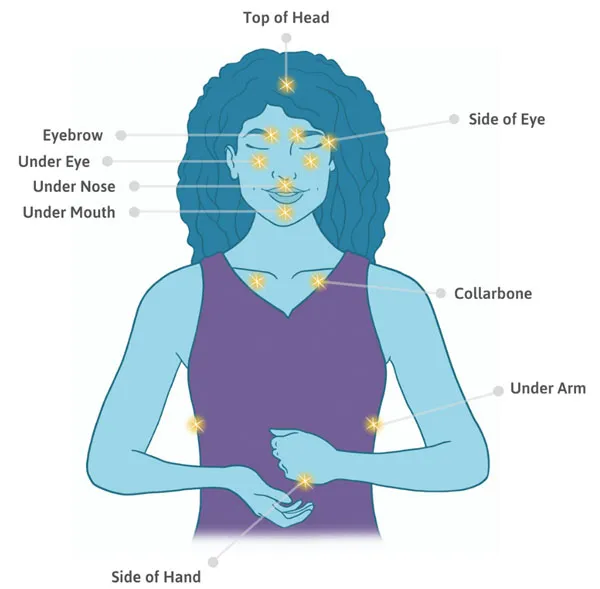
- Side of the Hand
- Eyebrow
- Side of the Eye
- Under the Eye
- Under the Nose
- Under the Mouth
- Collarbone
- Under the Arm
- Top of the Head
While using your fingertips to tap gently on these points, you focus on your emotion, memory, trigger, or whatever it may be. This may involve noticing how your body feels, playing a memory back like a movie in your mind, or repeating certain phrases out loud or in your mind.
Here’s the process, step by step:
- Identify the issue: Focus on a specific trauma-related problem you want to address. This might be a memory, a physical sensation, a strong emotion, or something else.
- Rate the intensity: On a scale of 0-10, how intense is the emotional charge, the physical sensation, the memory?
- Create a setup statement: This should acknowledge how you are feeling, while also accepting yourself, such as “Even though I feel anxious in my body when I think about ___, I deeply and completely accept myself."
- Repeat the setup statement three times: Say it out loud or in your mind while continuously tapping on the side of the hand point.
- Tap through the points: Gently tap each of the remaining points 5-7 times while focusing on the problem. You might reflect on the memory, play it out like a movie, or speak aloud your thoughts or feelings.
- Complete the sequence: After tapping the Top of the Head, take a deep breath.
- Re-rate the intensity: Has the intensity on the 0-10 scale gone down? If you don’t feel relief, repeat the process until you do.
To learn all about Tapping and master the basics of this technique, check out this comprehensive EFT Tapping guide.
Specific techniques for trauma release with EFT Tapping
When using EFT Tapping for trauma release, you may use a variety of techniques. These may include:
- Breaking down a traumatic memory into smaller details, such as visual memories, sounds, or emotions felt during or after the event.
- Focusing on physical sensations in your body when you feel triggered or emotionally aroused.
- Visualizing triggers in your mind, slowly exposing yourself to the trigger while reminding your mind and body you are safe in this moment.
- Using the “Movie Technique,” which involves running through the traumatic event in your mind like a movie, tapping through any intense emotions that arise.
Free. The best place to start.
Want to learn tapping from the people who know it best?
The Tapping World Summit has taught tapping to people all over the world since 2009. Ten days, 24 of the world's leading tapping teachers, 100% free.
Join the free summitTapping safely on trauma
Trauma work benefits from going slowly. A few ground rules make Tapping for trauma safer, whether you're doing it on your own between sessions or exploring something for the first time:
- Tap on the edges first. Start with how the memory feels right now in your body, the tightness, the racing heart, the general "charge", rather than diving straight into the most intense part of what happened. You can always go deeper once the edges have calmed down.
- Sneak up on it. Rather than reliving an event start to finish, use the Movie Technique above like a movie trailer: run through it briefly in your mind, stop the moment intensity spikes, tap until that spike comes down, then continue. You're never required to stay in the hardest part.
- Keep it general before you get specific. "This feeling," "this tightness in my chest," or "this memory" are safe places to start tapping. You don't have to narrate details out loud, to yourself or anyone else, for tapping to work.
- Work with a practitioner for big-T trauma. Tapping on everyday stress or a single unsettling moment is generally fine to do on your own. For combat trauma, abuse, assault, a major accident, or anything that meets the clinical bar for PTSD, work with a trauma-informed therapist or EFT practitioner who can help you pace the process.
Tapping supports the nervous system alongside professional care; it is not a replacement for therapy, medication, or a trauma-informed clinician, and it does not cure or treat PTSD as a diagnosis. If you're currently working with a therapist, tapping can be something you do between sessions or bring into the room with them.
Know when to stop. If tapping on a memory brings on a flashback, a sense of leaving your body or watching from outside yourself (dissociation), or you find yourself feeling more overwhelmed rather than calmer, stop the round, ground yourself (feel your feet on the floor, name five things you can see), and bring it to a therapist or EFT practitioner rather than pushing through alone. If you are in crisis or having thoughts of harming yourself, please reach out to a crisis line or emergency services right away.
A gentle round for feeling on edge
This round is for the everyday hypervigilance trauma can leave behind, jumpy, on guard, waiting for something to go wrong, not for reliving a specific event. If a traumatic memory comes up while you're tapping, that's a sign to work with a therapist or EFT practitioner rather than push through it here.
- Setup (repeat three times, tapping the side of your hand): "Even though I feel on edge right now and my body doesn't quite believe it's safe, I accept how I feel, and I'm open to feeling calmer."
- Eyebrow: "This on-edge feeling."
- Side of Eye: "My body is bracing for something."
- Under Eye: "Watching for danger that isn't here right now."
- Under Nose: "It's exhausting to stay this alert."
- Chin: "I don't have to figure anything out right now."
- Collarbone: "Right here, right now, I am safe."
- Under Arm: "Letting my shoulders come down, just a little."
- Top of Head: "Giving my body permission to stand down."
Take a breath and re-rate how on-edge you feel. A few rounds, done regularly rather than only in a crisis moment, teaches your nervous system that it's allowed to stand down more of the time.
Tapping for trauma guided demonstration
You can watch the Tapping for trauma process in real time in this demonstration of Tapping to Clear Traumatic Events:
As you watch, tap along with us. Even if this isn’t your exact issue, you’ll be surprised as to what happens when you tap along! 🙂
The science behind Tapping for trauma
Research shows that Tapping can significantly reduce cortisol levels (the stress hormone) by up to 43% in a single session. This reduction is vital for individuals dealing with trauma and PTSD, for whom daily stress can be so magnified.
Research on EFT Tapping for PTSD has shown promising results.
Studies have found that Tapping is very effective and provides significant benefit when treating PTSD, even holding its own against standard treatment options like CBT and EMDR.[1]
A study published in the Journal of Nervous and Mental Disease found that EFT Tapping was significantly effective in treating PTSD symptoms in veterans, with 90% of participants no longer meeting PTSD diagnostic criteria after just six sessions.[2] Our full review of what the research shows about tapping for veterans and combat PTSD digs deeper into these findings.
Tapping has even been ranked as one of the top two most effective techniques for treating PTSD in young people.[1]
We’ve also seen the benefits of using Tapping for healing in communities affected by traumas (including school shootings, natural disasters, and more), and these benefits have been documented worldwide.[3] Go here to read a heartwarming story of how Tapping helped parents affected by a school shooting heal.
Two trials, the same result
Two of the clinical trials behind that research are worth walking through side by side, because they replicate each other. In the first, published in the Journal of Nervous and Mental Disease, 59 veterans with diagnosed PTSD were split into a group that received six hour-long Tapping sessions and a group that stayed on their usual care while they waited. Afterward, 9 out of 10 veterans in the Tapping group no longer met the clinical criteria for PTSD, compared with roughly 1 in 25 in the waiting group. When the waiting group then received Tapping too, 60% no longer met the criteria after three sessions, rising to 86% after six. Among the 49 veterans who ultimately received Tapping, 80% were still below the diagnostic threshold at the six-month follow-up.
A second, independent trial set out to see if those results would hold up. Researchers recruited 58 veterans who again met the diagnostic criteria for PTSD, split into a "treatment as usual" group and a group who received six hour-long Tapping sessions with certified EFT practitioners. After six sessions, symptom scores dropped significantly across the board, and the improvement held at three- and six-month follow-ups, the same pattern as the first trial.
Research at a glance
| Study | Year | Design | N | What it found |
|---|---|---|---|---|
| Church, Hawk, Brooks, et al. | 2013 | RCT, J Nerv Ment Dis | 59 veterans | 9 of 10 in the Tapping group no longer met PTSD diagnostic criteria after 6 sessions, vs. roughly 1 in 25 in the waiting group |
| Geronilla, McWilliams, Clond & Palmer-Hoffman | 2016 | Replication trial | 58 veterans | Six Tapping sessions produced a very large drop in anxiety vs. usual care, replicating the first trial's pattern |
| Church, Yount, Rachlin, Fox & Nelms | 2016 | RCT, biomarker (Am J Health Promot) | 16 veterans | PTSD symptoms dropped by more than half and stayed down; six genes tied to PTSD showed measurably different activity after Tapping |
| Sebastian & Nelms | 2017 | Meta-analysis, Explore | 7 pooled trials | Weighted effect size d=2.96, among the largest reported in the PTSD treatment literature; Tapping performed comparably to EMDR and CBT where tested head-to-head |
| Karatzias, Power, Brown, et al. | 2011 | Controlled comparison | Comparison of CBT, EMDR & EFT | Tapping held its own against two gold-standard PTSD therapies |
For the fuller picture, including replication details and an honest look at where the evidence is still thin, see our complete review of the research on tapping for veterans and combat PTSD.
What our data shows
Across the Emotional Freedom category in The Tapping Solution App, 58 sessions built for processing stuck emotions, people have completed 4,022,551 sessions and rated the intensity of what they were feeling from 0 to 10 before and after. The average goes from 7.0 to 4.1, a 42% drop, in a single sitting (app data, not a clinical study).
One session built specifically for this: Instant Boost of Safety has been completed 65,203 times, with the average rating going from 6.1 to 3.7.
A larger, published study of 270,461 Tapping Solution App users found anxiety dropped an average of 44% and stress dropped 45% after using the app (Church & Stapleton, 2020, JMIR Mental Health). That's self-report data at scale, not a controlled trial, and it points the same direction as the smaller controlled studies above.
In their own words
"This session seems to lessen my heightened anxiousness. I feel relaxed and safe, more so than with my psych counselor."
Walt, 58 years of PTSD from his time as a Vietnam veteran, rated his anxiousness an 8 before tapping, a 1 after
"This session on stress really helped calm my nervous system. Before the session I felt like I wanted to crawl out of my body. Now I feel grounded and centered. Thank you!"
Janet, Release Stress, rated her stress a 10 before the session, a 3 after
Our proof library doesn't have a second PTSD-specific app-feedback quote that avoids naming abuse or crisis details, so the second quote above is a general calm/stress quote rather than a trauma-specific one.
Success stories of using Tapping for trauma and PTSD
Here are a few real-life stories from people who’ve used Tapping to heal from trauma or PTSD:
“It’s a daily struggle every day with CPTSD. In all my 81 yrs I’ve never believed I could feel peace. In the last 4 yrs of daily tapping I’m having moments of healing and peace, and finally sharing my deep sense of aloneness and fear with others I feel safe with.” -Pamela
“I suffer from agoraphobia, anxiety, and C-PTSD and these meditations are really helping me a great deal! I am becoming less hypervigiliant and able to focus on what I am doing instead of get distracted and need to investigate every sound I hear. My stress level is decreasing, and I feel much more relaxed. I am happier! Life is more enjoyable! These are miracles for me and give me hope that I can recover from C-PTSD and past trauma” - Andrea
“Tapping has been invaluable in helping heal C-PTSD and chronic anxiety. My true and healthy self is emerging, and I am beyond grateful.” -Carol
“Tapping has helped me deal with the fallout from years of PTSD… It is amazing that just a few moments can have such a dramatic positive effect. If you are on the fence about it PLEASE just try it. I was worried in the beginning-it sounded like nonsense to me and I wanted to make sure I practiced where no one could see me! I scoffed and would have missed out on a life changing technique.” -David
“Life-changing. I've been struggling with low self-esteem for years due to trauma. I have done this tapping meditation and other energy medicine protocols for several years, and this time, I was ready. In one week I went from complete overwhelm to inner peace. Thank you.” -Andrea
“As a person that has had a lot of trauma in my life, some as an unknown source, tapping has helped me feel PEACEFUL and secure. I have been able to sleep better & change my thinking.” -Tesser
Start your own healing journey with Tapping for trauma
For many of us, traumatic events don’t just happen once. They may only literally happen once in “real” time, but we replay them, hold onto them, and run through them again and again and again. When we let go of patterns keeping us stuck in fight-or-flight with the help of Tapping, we can truly heal the past and transform our futures. That includes sudden losses too, like the grief of losing a pet, grief the world often calls small, which can carry every bit as much of an emotional charge as any other trauma.
If you’ve been affected by trauma in your life, Tapping can be an extremely effective tool to support your healing.
When using Tapping for ptsd or trauma, intense emotions may arise. Here are some tips to help you on your journey:
- Start slow and gentle. Tap on one aspect at a time rather than the whole traumatic event. Keep it general at first (like “this feeling”) rather than more specific details. Take it step by step.
- Take breaks and practice self-care throughout the process.
- Work with a qualified professional to safely process your trauma. Many therapists use EFT in their practice, and they may be able to combine different techniques along with Tapping to help you heal.
You can find experienced EFT Practitioners to support you online through our directory here.
I encourage you to try The Tapping Solution App, which features guided Tapping sessions specifically designed for helping to calm the amygdala, quiet the fight-or-flight response, and allow your brain and body to finally settle into a state of greater peace and ease.
- Instantly reduce anxiety and stress
- Fall asleep faster and sleep better
- Boost productivity, stay motivated
- Relieve chronic or occasional pain
- Release anger, find peace


Download the app for free today from your preferred app store, and you’ll find hundreds of options ready for you. Everything from “Stop a Panic Attack” to “Feeling Safe and Secure,” to “Releasing Fear,” we've got a meditation for every need.
Our Trauma Support Category includes a 5-Day Transforming Trauma Series led by psychotherapist Dr. Arielle Schwartz, which is a great place to start your healing journey!

Click here on your mobile device to access this series, or open The Tapping Solution App and search for “Transforming Trauma.”
Remember, healing is possible. With tools like Tapping, support from professionals, and your own courage and resilience, you can move beyond trauma and reclaim your life.
If you want to go deeper on this in book form, my book The Tapping Solution is a good place to start.
Until next time… Keep Tapping!
Nick Ortner
Go deeper
- Our full review of the research on tapping for veterans and combat PTSD goes much deeper than the table above, including a section on where the evidence is still thin.
- Stories of healing from childhood trauma, from people who've used Tapping alongside their own care.
- The basic Tapping sequence for anxiety, if anxiety and hypervigilance are the most present symptom right now.
- Nervous system regulation: what it actually means and how to do it, for the wider picture beyond trauma-specific tapping.
- The EFT tapping chart, if you want the 9 points at a glance.
Tap along with me
Watch a real trauma recovery story here, a former NYPD officer who used tapping to heal in ways that back up everything above.
Tapping for Trauma and PTSD: Your Questions, Answered
Does tapping help with trauma?
Many people find that Tapping lowers the intensity of a traumatic memory or the hypervigilance that trauma leaves behind. Controlled trials in veterans with PTSD have found large, replicated drops in symptoms after Tapping. Tapping works alongside professional care, not in place of it, and it does not cure or treat PTSD as a diagnosis.
Can tapping help PTSD?
Research on veterans with diagnosed PTSD has found significant, replicated symptom improvement after Tapping, including one trial where 9 of 10 participants no longer met the clinical criteria for PTSD after six sessions. Tapping is used alongside a trauma-informed clinician's care for a PTSD diagnosis, never as a replacement for it.
Is it safe to tap on trauma alone?
For everyday stress, hypervigilance, or a single unsettling moment, tapping on your own is generally fine. For combat trauma, abuse, assault, or anything that meets the clinical bar for PTSD, work with a trauma-informed therapist or EFT practitioner rather than processing it alone.
What is the Movie Technique?
The Movie Technique is a way of sneaking up on a difficult memory instead of reliving it all at once. You run through the event briefly in your mind, like a movie trailer, stop the moment the intensity spikes, tap until that spike comes down, and only then continue. It lets you process a memory in pieces small enough to stay manageable.
What does the research say about tapping for PTSD?
Two controlled trials in veterans with diagnosed PTSD, 59 and 58 participants, found that roughly 80-90% no longer met PTSD diagnostic criteria after six Tapping sessions, with results holding at 3 and 6 month follow-ups. A 2017 meta-analysis of seven trials found one of the largest effect sizes reported in the PTSD treatment literature, and a head-to-head comparison found Tapping held its own against CBT and EMDR. See our full research review for the complete picture, including where the evidence is still thin.
How do I find a trauma-trained EFT practitioner?
Our practitioner directory lets you search for certified EFT practitioners, many of whom list trauma as an area of focus. If you're already working with a therapist, ask whether they're familiar with EFT or open to you bringing it into your sessions together.
What's the difference between everyday stress and big-T trauma for tapping?
Everyday stress and a single unsettling moment respond well to tapping on your own, the way you would for anxiety. Big-T trauma, like combat, abuse, or assault, meets the clinical bar for PTSD and works best with a trauma-informed therapist or EFT practitioner guiding the pace, so you're not reliving more than your nervous system can handle at once.
How many tapping sessions does it typically take?
In the controlled trials above, veterans with diagnosed PTSD saw significant, lasting symptom drops after six one-hour Tapping sessions. Everyday hypervigilance and stress can ease in a single short round, though regular practice, not a single session, is what teaches the nervous system it's allowed to stay calmer more of the time.
References
- Mavranezouli I, Megnin-Viggars O, Daly C, et al. Research Review: Psychological and psychosocial treatments for children and young people with post-traumatic stress disorder: a network meta-analysis. Journal of Child Psychology and Psychiatry. 2020;61(1):18-29.
- Church D, Hawk C, Brooks AJ, Toukolehto O, Wren M, Dinter I, Stein P. Psychological trauma symptom improvement in veterans using emotional freedom techniques: a randomized controlled trial. J Nerv Ment Dis. 2013 Feb;201(2):153-60.
- Feinstein, D. Uses of Energy Psychology Following Catastrophic Events. Frontiers in Psychology. 2022;12.


