Anxiety can feel overwhelming, impacting our daily lives and wellbeing. Fortunately, Emotional Freedom Techniques (EFT), also known as Tapping, offers a simple yet powerful tool to help manage anxiety symptoms.
This guide will walk you through a basic Tapping sequence specifically designed for anxiety relief. Whether you're new to Tapping or looking to refine your technique, these steps can help you find calm and balance when anxiety strikes.
Looking for more support? You can also tap along to our Releasing Anxiety Tapping meditation in The Tapping Solution App, or go deeper with a behind-the-scenes look at the app's 5-Day Release Anxiety Program. In a peer-reviewed study of 270,461 app users, self-rated anxiety dropped by an average of 44% in a single session (Church & Stapleton, 2020, JMIR mHealth and uHealth).
And if you just want to tap along with a free, guided session right now, our Releasing Anxiety tap-along below is the fastest way in.
Does tapping work for anxiety?
Yes, and this is one of the most studied uses of EFT tapping. In a peer-reviewed study of 270,461 people using guided tapping sessions (Church & Stapleton, 2020), self-rated anxiety dropped from an average of 6.7 to 3.8 on a 0-10 scale in a single session, a 44% average reduction. A systematic review of clinical EFT research (Frontiers in Psychology, 2022) found consistently strong results for anxiety across randomized controlled trials. And the mechanism is physical, not just psychological: a replicated randomized trial led by Dr. Peta Stapleton found significant reductions in cortisol, the body's main stress hormone, after tapping.
Tapping works for anxiety by combining exposure (naming what you feel) with stimulation of acupressure points, which research suggests sends calming signals to the amygdala, the brain's threat center (Feinstein, 2025). In plain terms: you think about the thing that makes you anxious while your body gets the message that you're safe.
Anxiety, the Amygdala, and Fight or Flight

Anxiety is our body's way of reacting to stress and alerting us to potential dangers. When we are stressed, a part of our brain called the amygdala fires into action and triggers the stress response. The amygdala's job is to help us survive and to protect us from danger.
You might have heard of this referred to as the "fight-or-flight" response. It's a natural instinct leftover from way back when our ancestors had to cope with life-or-death situations, like running from tigers and bears in the wild to stay alive.
An overworked system
Nowadays, we aren't often facing such life-or-death situations. However, our nervous systems are still programmed to be on high alert for potential dangers. And the stress response of the amygdala is still very much ready for action at all times.
In fact, everyday situations in the modern world can, in no time at all, elicit that same fight-or-flight response. It can happen whenever we perceive a threat of any sort, which often occurs when we are actually in no real danger.
Sometimes, it might be something big. Financial concerns, a major life change, or a global conflict can all fuel anxiety and kick our bodies into a state of fight or flight. But other times, it doesn't take much at all to get anxiety off and running. Anxiety might be triggered by sitting in a traffic jam, being too busy with work projects, or having a tense conversation with a partner. It's common to experience anxiety when taking a test, public speaking, or meeting new people. For some people, it's the body itself that becomes the trigger, with every ache or racing heartbeat sparking a new wave of worry, which is where tapping for health anxiety can help.
Our body's fight-or-flight mode can end up staying on all the time, and that really begins to take a toll on our mental and physical health. But here's the good news: you can learn to reprogram your brain and body to release that anxiety, and free up energy for a life that feels more balanced, calm, and at ease. Tapping on the nine points while thinking about what's stressing you sends the amygdala a different signal: this is safe. That's the mechanism behind the sequence below.
Free. The best place to start.
Want to learn tapping from the people who know it best?
The Tapping World Summit has taught tapping to people all over the world since 2009. Ten days, 24 of the world's leading tapping teachers, 100% free.
Join the free summitWhy is my anxiety worse in the morning?
There is a biological reason mornings hit hardest. Cortisol, your main stress hormone, naturally peaks in the first 30 to 45 minutes after waking. It is called the cortisol awakening response, and it happens to everyone. It is your body's way of getting you up and moving.
The problem comes when your baseline stress is already high. That normal morning surge lands on an already loaded system, and the combination can feel like waking directly into dread: heart going before your feet touch the floor, a heavy sense that the day is already too much, sometimes before you can even name what you are dreading. Nothing is wrong with your body. The surge is normal. The load it is landing on is the part you can work with.
That is where a short morning tapping practice fits. Two suggestions. First, tap before you pick up your phone; email and news stack fresh stress on top of the surge at its exact peak. Second, be specific. Instead of tapping on "morning anxiety," ask what today's dread is actually about: the meeting, the conversation you have been putting off, the general sense of being behind. Name that, notice where it sits in your body, and tap through the points below while the cortisol wave crests and passes.
You are not fighting your biology. You are letting a normal surge move through a calmer body. If 3 a.m. is more your problem than 7 a.m., here's what's different about anxiety that wakes you at night.
The basics of the Tapping process for anxiety
- Always begin Tapping on the side of the hand point while you repeat the setup statement to yourself. This allows you to be honest with how you feel and sets you up for the Tapping process (more on the setup statement below).
- Begin Tapping while focusing on how you feel or on the problem. By doing this you send a calming signal to your brain, allowing you to think of the problem without feeling stress in your body.
- When you feel better, you can move to more empowering thoughts. The same way you need to weed a garden before you plant seeds, you have to release the intensity of what you're feeling before more empowering thoughts can take root.
Want to learn more Tapping basics? Check out this comprehensive guide on how to do Tapping.
How to do Tapping for anxiety: Let’s break down the steps
Here are the steps you’ll want to follow to try the Tapping technique for anxiety:
- Identify the problem on which you want to focus. It can be general anxiety, or it can be a specific situation or issue which causes you to feel anxious, like a thought that keeps looping no matter how many times you try to let it go.
- Assess how you feel. Consider the problem or situation. How do you feel about it right now? Rate the intensity level of your anxiety on a scale of 0 to 10, with zero being the lowest level of anxiety and ten being the highest.
- Compose a setup statement. Your setup statement should acknowledge the problem you want to deal with, then follow it with a phrase of acceptance. This helps neutralize any judgments you may have around how you feel and allow you to be more honest with your Tapping. Here are some example setup statements:
- "Even though I feel this anxiety, I accept how I feel"
- "Even though I'm anxious about my interview, I accept myself and how I feel."
- "Even though I'm feeling this anxiety about my financial situation, I honor my feelings and give my body permission to relax."
- Start Tapping on the side of the hand. Take a deep breath, and then start Tapping! While Tapping on the side of the hand point (on the outer edge of the hand, on the opposite side from the thumb), repeat the setup statement three times aloud.
- Tap through the rest of the points. Now, tap about 5 to 7 times each on the remaining eight points in the sequence described below. As you tap on each point, repeat a simple reminder phrase, such as "my anxiety" or "my interview" or "my financial situation" to help you mentally focus on your issue.
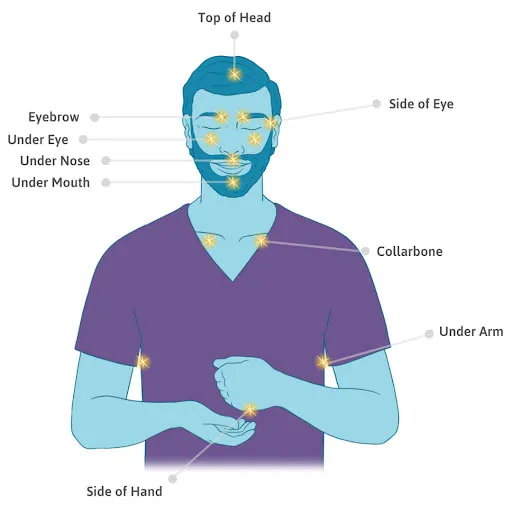
Eyebrow Point (EB)
Where the eyebrows begin, closest to the bridge of the nose.
Side of Eye (SE)
On the bone directly along the outside of either eye.
Under Eye (UE)
On the bone directly under either eye.
Under Nose (UN)
The area directly beneath the nose and above the upper lip.
Chin Point (CP)
This is the area just below your bottom lip and above the chin, right in the crease.
Collarbone Point (CB)
Starting from where your collar bones meet in the center, go down an inch and out an inch on either side.
Under Arm (UA)
On your side, about four inches beneath the armpit.
Top of Head (TH)
Directly on the crown of your head.
- Reassess how you feel. Now that you've completed the sequence, focus on your problem again. How intense is the anxiety now, in comparison to a few minutes ago? Give it a rating on the same 0 to 10 scale. Did you notice a shift?
- Repeat as needed. If your anxiety level is still higher than 2 or 3, you can do another round of Tapping. Keep tapping through the sequence until the anxiety is gone. You can change your setup statement slightly to take into account your efforts to fix the problem or your desire for continued progress.
Examples:
"Even though I have some remaining anxiety, I accept how I feel and choose to relax."
"Even though I'm still a little worried about this interview, I deeply and completely accept myself." And so on.
- Introduce more empowering thoughts. Now that you've focused on dispelling your immediate anxiety, you can work on instilling some positive feelings in its place. Keep tapping through the Tapping points in sequence while repeating empowering statements, such as:
"I have faith in my ability to change."
"I am joyful about these positive changes."
"I am accomplishing so much."
"I enjoy the calm and peace that I have."
"I love the person that I am."
"I am becoming a more relaxed and joyful person."
This approach is different from traditional "positive thinking." You're not being dishonest with yourself. You're not trying to obscure the stress and anxiety inside yourself with a veneer of insincere affirmations. Rather, you've confronted and dealt with the anxiety and its corresponding negative emotions, offering deep and complete acceptance to both your feelings and yourself.
The same way you need to weed a garden before you plant seeds, you have to release the intensity of what you're feeling before more empowering thoughts can take root. That's what makes Tapping so much more effective than the "positive thinking" techniques that many of you have already tried.
Congratulations! You've completed your first Tapping sequence for anxiety!
Tapping meditation for anxiety: Follow along with me in this video!
Do you need to release a little anxiety right now?
Then take just a few minutes to watch this video and tap along with me! I’m willing to bet you’ll feel so much better afterward. 🙂
Now part of a Medicare program
A quick note for readers on Medicare. This sequence is the same one at the heart of NeuroTap Health, our sister company's guided program for adults living with anxiety, depression, or chronic pain. If you have Original Medicare, the whole program is $0 out of pocket, no credit card ever. Here's how it works.
What 4 million anxiety sessions show
The studies above are what convinced the researchers. Here's what convinced me. In The Tapping Solution App, people rate how they feel from 0 to 10 before and after every session, and we keep that data. In our Emotional Freedom category, the home of our anxiety sessions, people have completed just over 4 million rated sessions. The average rating going in is 7.0. The average coming out is 4.1. That's a 42% drop, measured in the moment, across 58 different sessions.
One session carries a lot of that weight. Releasing Anxiety, a free session my sister Jessica recorded, has been completed nearly 1.8 million times, with an average rating of 6.8 before and 4.1 after. It's just over nine minutes long. If you want to know whether tapping works for your anxiety, that session is the fastest way to find out.
To be clear about what this is: self-report, within a single session, from people who chose to tap. It isn't a controlled trial, and it doesn't replace the trials above. It is the largest set of tapping-and-anxiety data anywhere, and it says the same thing the trials say.
"Absolutely baffled! I'm literally fighting tears of joy to write this."
Brandi, lifelong anxiety, skeptical convert
"I am amazed. I am slightly stumbling with words! From Ten, to Zero! That's how I feel right now! The questions and statements within the Meditation are perfect. I could see and feel where the anxiety started. I have hope now, as well as faith!"
Lisa, Day 4: Releasing Anxiety in the Mind, rated her anxiety a 10 before the session, a 0 after
Tips to help you get started with the Tapping technique
- Use a firm but gentle pressure, the same as if you were drumming on the top of your desk or testing a melon for ripeness.
- You can use all four fingers, or just one or two (usually the index and middle fingers). Four fingers are generally used on wider areas, while just one or two can be used on sensitive areas, such as around the eyes or under the nose.
- You can tap one side of the body or both at the same time. The meridian points are symmetrical on either side of the body.
While this guide provides a solid foundation for using Tapping to address anxiety, many people find it helpful to have guided support, especially when first starting out. The Tapping Solution App offers a variety of guided Tapping meditations specifically designed for anxiety relief. In fact, in a peer-reviewed study of 270,461 app users, self-rated anxiety dropped from 6.66 to 3.75 on a 0-10 scale, an average 44% reduction in a single session (Church & Stapleton, 2020, JMIR mHealth and uHealth).
The app provides step-by-step audio guidance, visual cues for Tapping points, and a wide range of topics to address various anxiety triggers. Whether you're dealing with general anxiety, specific phobias, or situational stress, the app can be a valuable tool in your anxiety management toolkit.
Download The Tapping Solution App today to access these resources and take your Tapping practice to the next level.
- Instantly reduce anxiety and stress
- Fall asleep faster and sleep better
- Boost productivity, stay motivated
- Relieve chronic or occasional pain
- Release anger, find peace


Remember, consistent practice is key to experiencing the full benefits of Tapping. With regular use, you may find yourself better equipped to handle anxiety and stress in your daily life.
If you're ready to go deeper than a single sequence, our Tapping Solution for Anxiety Relief program is a full 6-module system for working with anxiety at its root.
Until next time… Keep Tapping!
Nick Ortner
Go deeper
- EFT Tapping Chart: Getting to Know the 9 Main Tapping Points
- EFT Tapping Phrases
- EFT Tapping Scripts
- Releasing Anxiety: Tap Along With Me
- Why You Wake Up Anxious at 3 A.M.
- Tapping for Panic Attacks
- If you'd like to work with someone one-on-one, our practitioner directory lists independent EFT practitioners who work online and in person.
Tap along with me
Grab nine minutes and tap along with me through this anxiety relief meditation, using the exact sequence we just walked through.
Tapping for Anxiety: Your Questions, Answered
Does tapping work for anxiety?
Yes. In a peer-reviewed study of 270,461 people using guided tapping sessions (Church & Stapleton, 2020), self-rated anxiety dropped 44% on average in a single session. Randomized trials have also found reductions in cortisol, the body's main stress hormone, after tapping.
Why is my anxiety worse in the morning?
Cortisol naturally peaks in the first 30 to 45 minutes after waking. When your baseline stress is already high, that normal surge lands on a loaded system and can feel like waking into dread. Tapping before you pick up your phone, on whatever today's dread is actually about, lets the surge pass through a calmer body.
How long does tapping take to work for anxiety?
Most people feel a shift within one session of 5 to 10 minutes. Across 4 million rated anxiety sessions in our app, the average rating goes from 7.0 to 4.1 in that time. Lasting change on a long-standing pattern takes repetition, so a short daily practice does more than an occasional long one.
What do I say while tapping for anxiety?
Start at the side of the hand with a setup statement that names the feeling: "Even though I'm anxious about this presentation, I deeply and completely accept myself." Then tap through the points with a short reminder phrase like "this anxiety" or "this tightness in my chest." Be specific about what today's anxiety is about; it works better than tapping on "anxiety" in general.
Can I tap during a panic attack?
Yes, and many people do. Tap the collarbone point or the side of the hand, whichever you can reach easily, and breathe slowly while you tap. You don't need the full sequence or the right words in that moment. If panic attacks are frequent or severe, tapping works alongside care from a doctor or therapist, not instead of it.
Is tapping for anxiety a placebo?
Studies comparing real tapping points against sham points found the real points outperformed the sham, which is the standard test for an effect beyond placebo. The cortisol trials point the same way: a measurable change in stress hormones, not just in how people say they feel.
Is there a free tapping session for anxiety?
Yes. Releasing Anxiety is free in The Tapping Solution App and has been completed nearly 1.8 million times. You can also tap along with me here on the blog.


