Tap along with your child in the app
The Tapping Solution App has guided sessions for kids, teens, and parents, plus a free trial. Join the community behind more than 32 million tapping sessions.
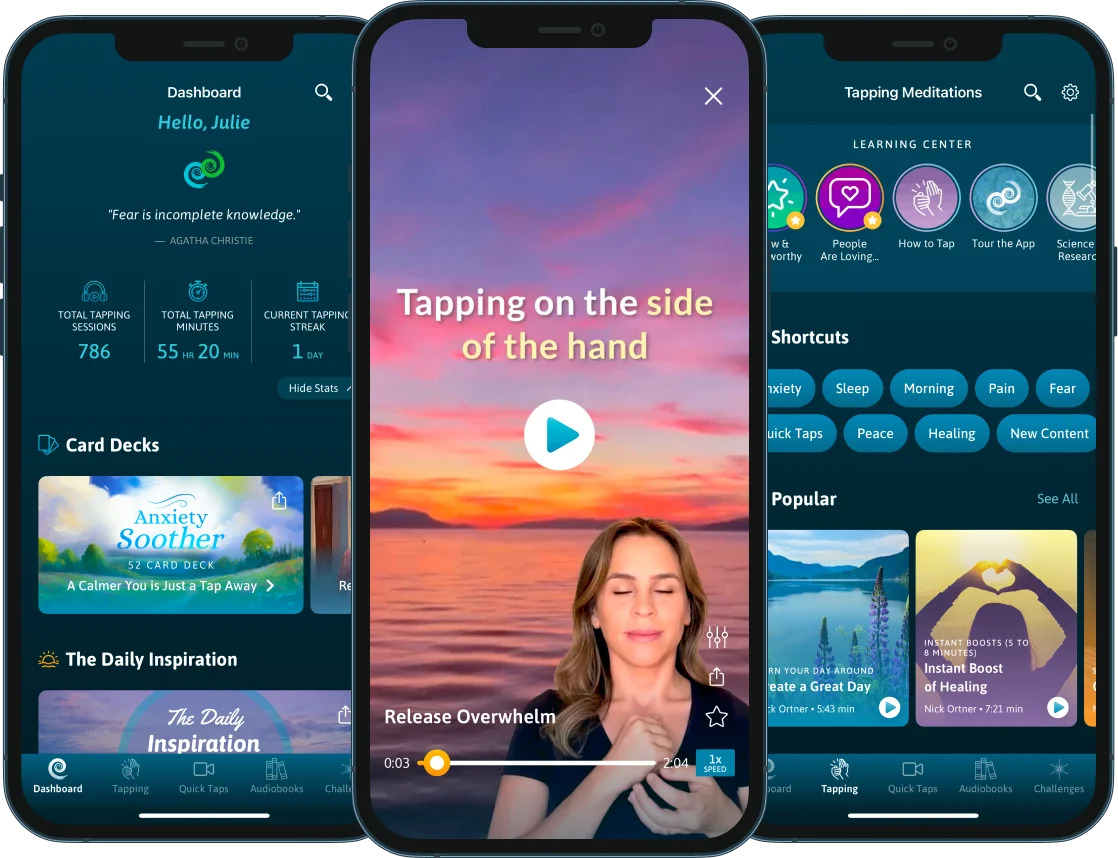
A simple, child-friendly way to help your kid work through anxiety, big feelings, and stressful moments, with step-by-step instructions, expert audio sessions, and real Tapping videos to watch together.
Kids can feel anxious for all kinds of reasons: school pressure, social dynamics, family changes, social media, and more. Anxiety in children is on the rise. Tapping (EFT) offers a simple, child-friendly tool that can help kids manage those feelings in the moment.
Below you'll find how Tapping helps kids with anxiety, a 5-step guide to tapping with your child, practical tips, guided audio sessions from Tapping experts, and videos you can watch together. For more resources by age, visit our Kids & Parents hub.
You don't need to be an expert to tap with your child. Keep it simple, keep it light, and follow their lead.
Kids often learn Tapping quickly, and with less emotional resistance than adults, it tends to work fast. Bringing Tapping into your child's life early, while habits are still forming, gives them a life skill for building emotional resilience they can carry with them.
If your child's anxiety centers on a specific worry like a test or a social situation, our tapping sequence for anxiety walks through the same round in more detail. Pairing Tapping with slower breathing also helps many kids settle faster: see our mindful breathing exercises for kids and printable tapping point diagrams for kids for more ways to practice together.
Across 27 Tapping for Kids sessions in The Tapping Solution App, spanning 198,260 completions, the average child-reported intensity drops from 5.6 to 2.8, a 50% drop, the single largest completion-weighted drop of any category in the app (app data).
In a separate independent study of 270,461 Tapping Solution App users, tapping was associated with a 44% average drop in anxiety and a 45% average drop in stress (Church & Stapleton, 2020, JMIR mHealth and uHealth). This is self-reported app data, not a controlled trial of children specifically, but it's the closest independent look we have at the same pattern showing up at scale.
Thank you for this wonderful relaxing session. My eldest son has taken really well to tapping and listening to this before bed. He normally really struggles to fall asleep on his own and can take him hours to switch off. Tonight was the third night listening and at the end all he said was 'I'm a really low number' and went to sleep!
Natasha, on her son falling asleep after tapping (8 to 1 in 3 nights)
Listen to these sessions from practitioners who specialize in tapping with kids, teens, and the parents supporting them.
We know that many adult issues stem from childhood experiences, so wouldn't it be amazing to help our children work through their issues while they're still young? Dr. D'Eramo, a traditionally trained MD, discovered the results Tapping could produce and now uses it in her own practice, teaching other doctors how to bring it into theirs. Whether you're a parent or a practitioner, you'll learn the key elements for tapping with children, how to approach physical, emotional, and behavioral issues, hands-on advice for weaving Tapping into your relationship with your kids, and what to do when you feel frustrated and unsure how to help.
Tamara Donn helps stressed, overwhelmed moms build new habits so they can be more present with their children, more productive with their time, and experience more peace in their lives. In this session she teaches how to fit Tapping into a busy schedule and get real results.
In this session, learn how to approach teens specifically and help them use Tapping in a way that fits their age and stage.
When it comes to ADD and ADHD, most focus goes to helping the child, but the parent is often overlooked. Many parents struggle with the exhaustion and perseverance it takes to support a hyperactive child, and having a child with special needs puts real pressure on the family. In this session, Paul Keene teaches parents to support themselves both individually and as a couple, and to use that connection to help create more peace in the home.
In this session you'll learn how social media may be adding to your child's anxiety, a quick and reliable way to tap to calm yourself and your children, and a simple technique for making Tapping a fun, exciting activity for kids.
Want a visual on how to tap with your child? The videos below give you an idea of how you can do it together.
Stress Relief for Kids
Stress Relief for Children - Tapping Solution Foundation in Schools
Tapping for Kids – EFT with Brad Yates
Tapping for Kids – Fear – EFT with Brad Yates
Tapping for Kids – Sadness – EFT with Brad Yates
Tapping for Kids – Sports – EFT with Brad Yates
Tapping is a simple stress management tool that can empower your child to manage their emotions and find relief from anxiety. For more age-specific tools, books, and app sessions for your family, visit our Kids & Parents hub.
The Tapping Solution App has guided sessions for kids, teens, and parents, plus a free trial. Join the community behind more than 32 million tapping sessions.
There's no set minimum age. Even very young kids can be guided through tapping by a parent using simple words and a hand-span instead of a 0-10 scale. As kids get older, they can learn the points themselves and use Tapping more independently.
No. Use their words, not a script. Kids often can't articulate exactly what they're feeling, so it's okay to guess or offer suggestions, and even to keep it playful or silly while still tapping through the points.
It can be as short as a minute or two of "first aid" tapping in a tough moment, or a longer guided session like the audios above. There's no set length -- follow your child's attention span and stop once they feel better.
Tapping is a simple, gentle self-soothing tool, but it isn't a substitute for professional care. For persistent or severe anxiety, or if you're ever unsure, talk to a pediatrician or a licensed mental health professional.
The Tapping Solution App includes guided sessions built specifically for children and the parents supporting them.
Important Notice: The Tapping Solution App is intended for general wellness purposes, including stress management and emotional wellness support. It is not intended to diagnose, treat, cure, or prevent any disease or medical condition. If you have been diagnosed with a medical or mental health condition, please consult with your healthcare provider. This app is not a substitute for professional medical advice, diagnosis, or treatment.