
The video below, originally filmed for our 2013 Tapping World Summit, has Nick and Jessica discussing what tapping is and how you can begin to use this tool immediately. Press play below to watch this interview now!
Millions of people are settling for lives filled with poor health and emotional baggage. Not knowing how to achieve the joyful and satisfying lives they desire, they’re stuck accepting a lifestyle of emotional trauma, chronic physical pain, compulsions and addictions, or perhaps just an empty feeling inside. Along with these problems come pills to kill the pain, sleep at night, and suppress anxiety – but this is hardly better than the disease.
If you’re like many people, you feel trapped, caught in this cycle. You’re tired of feeling sad, depressed, anxious, discontent, and unwell. You’re sick of the expensive and ineffective treatments. You’re fed up with relinquishing the power over your health and happiness to psychologists and doctors. You’d like to grow, flourish, and thrive, putting the past in the past. You want to be your best, living a life that is filled with peacefulness, joy, and fulfillment, from day to day and moment to moment.
With Tapping, you can do that. You can discover the vital secret for emotional wholeness and physical relief. You can take your physical and emotional well-being into your own hands. It’s simple for anyone to master, and it’s free.
Tapping provides relief from chronic pain, emotional problems, disorders, addictions, phobias, post traumatic stress disorder, and physical diseases. While Tapping is newly set to revolutionize the field of health and wellness, the healing concepts that it’s based upon have been in practice in Eastern medicine for over 5,000 years. Like acupuncture and acupressure, Tapping is a set of techniques which utilize the body’s energy meridian points. You can stimulate these meridian points by tapping on them with your fingertips – literally tapping into your body’s own energy and healing power.
Your body is more powerful than you can imagine… filled with life, energy, and a compelling ability for self-healing. With Tapping, you can take control of that power.
All negative emotions are felt through a disruption of the body’s energy. And physical pain and disease are intricately connected to negative emotions. Health problems create feedback – physical symptoms cause emotional distress, and unresolved emotional problems manifest themselves through physical symptoms. So, the body’s health must be approached as a whole. You cannot treat the symptoms without addressing the cause, and vice-versa.
The body, like everything in the universe, is composed of energy. Restore balance to the body’s energy, and you will mend the negative emotions and physical symptoms that stem from the energy disruption. Tapping restores the body’s energy balance, and negative emotions are conquered.
The basic technique requires you to focus on the negative emotion at hand: a fear or anxiety, a bad memory, an unresolved problem, or anything that’s bothering you. While maintaining your mental focus on this issue, use your fingertips to tap 5-7 times each on 12 of the body’s meridian points. Tapping on these meridian points – while concentrating on accepting and resolving the negative emotion – will access your body’s energy, restoring it to a balanced state.
You may be wondering about these meridians. Put simply, energy circulates through your body along a specific network of channels. You can tap into this energy at any point along the system.
This concept comes from the doctrines of traditional Chinese medicine, which referred to the body’s energy as “ch’i.” In ancient times, the Chinese discovered 100 meridian points. They also discovered that by stimulating these meridian points, they could heal. Call it energy, call it the Source, call it life force, call it ch’i… Whatever you want to call it, it works.
In some ways, Tapping is similar to acupuncture. Like Tapping, acupuncture achieves healing through stimulating the body’s meridians and energy flow. However, unlike Tapping, acupuncture involves needles! “No needles” is definitely one of the advantages of Tapping.
Acupuncture also takes years to master. Acupuncture practitioners must memorize hundreds of meridian points along the body; the knowledge and training take years to acquire.
Tapping is simple and painless. It can be learned by anyone. And you can apply it to yourself, whenever you want, wherever you are. It’s less expensive and less time consuming. It can be used with specific emotional intent towards your own unique life challenges and experiences. Most importantly, it gives you the power to heal yourself, putting control over your destiny back into your own hands.
Like many healing arts that draw upon ancient wisdom, Tapping has been met with a fair share of skepticism. Many doctors and psychologists have been quick to dismiss it as “woo woo”, despite the heaping anecdotal evidence from practitioners and people who have used EFT on their own.
In recent years however, there’s been a growing pool of undeniable research that proves what millions of people the world over have known for some time now: that EFT produces real, lasting breakthroughs and significantly improves or even eliminates conditions that hospital treatments, medication and years of psychotherapy often fail to adequately deal with.
Studies done at no less than Harvard Medical School verify these assertions. Research done at the prestigious university during the last decade found that the brain’s stress and fear response – which is controlled by an almond-shaped part of your brain called the amygdala – could be lessened by stimulating the meridian points used in acupuncture, acupressure, and of course, tapping.
Although these studies focused on acupuncture and as such, used needles, follow-up double-blind research revealed that stimulating the points through pressure, as we do in tapping, gave rise to a similar response!
Another exciting set of research was undertaken by Dr. Dawson Church. His team performed a randomized controlled trial to study how an hour-long tapping session would impact the stress levels of 83 subjects. To do this, Dr. Church and his team measured their level of cortisol, a hormone secreted by the body when it undergoes stress. Their findings? The average level of cortisol reduction was 24%, with a whopping reduction of almost 50% in some subjects! In comparison, there was no significant cortisol reduction in those who underwent an hour of traditional talk therapy.
Dr. Church also created The Stress Project, which teaches tapping to war veterans suffering with PTSD. The results have been astounding: an average 63% decrease in PTSD symptoms after six rounds of tapping. It’s mind-blowing and exciting research, which has converted many non-believers in the scientific community along the way. All signs indicate that this trend of revealing research and swayed skeptics will continue as millions of people around the globe continue to discover the power of tapping.


It began in 1980, with a psychologist by the name of Roger Callahan, and a patient with an extreme phobia of water. Mary’s fear of water controlled her life and kept her from daily activities. She was unable to take her children to the beach and was unable to drive near the ocean; she grew fearful when it rained, and could not even withstand the sight of water on TV. She had vivid nightmares involving water.
Dr. Callahan and Mary had been working on this problem together for over a year. Finally, Mary worked up the courage to sit within sight of the pool at Dr. Callahan’s house. Even doing this caused Mary extreme distress, and though she found ways to cope with the intense fear and emotional pain, she did not overcome her phobia. They discussed her problem, and how to overcome it, but without success.
Her fear of being near the water caused Mary stomach pains – a common “gut reaction.” Dr. Callahan had recently been studying traditional Chinese medicines, and learning about meridians. Suddenly he had an inspiration. Remembering that there was an acupuncture point for the stomach meridian on the cheekbone, he asked her to tap there, thinking it might cure her stomach pains.
Mary tapped her cheekbone as directed, and this little action changed medicinal history! The response seemed miraculous, to both Mary and Dr. Callahan. Her stomach pains disappeared. But even more amazingly, her phobia of water disappeared, too! She ran down to the pool and began splashing herself with water, rejoicing in her newfound freedom from fear.
Based on this discovery, Dr. Callahan began a series of investigations to develop and refine this technique, which he termed Thought Field Therapy. Gary Craig trained under Dr. Callahan’s tutelage in the 1990’s, learning the procedures for TFT. As time passed, Craig began to observe some problems with TFT, aspects that he saw were unnecessary complications.
TFT required practitioners to tap on a specific sequence of meridians (called an algorithm) for each different problem. Diagnosing the problem required a technique called muscle testing, wherein the practitioner would measure the relative strength of a muscle, while the patient explored various thoughts or statements.
Craig observed repeated scenarios in which the problem was incorrectly diagnosed or the practitioner tapped out the meridian points in the wrong order, yet the patient was still helped.. Based on these observations, he concluded that it did not matter in which order the meridian points were tapped.
Craig developed EFT as a simplified, improved version of the concepts behind Callahan’s TFT. EFT has one basic, simple sequence of points to tap, no matter what the situation.
Because of this, thousands of people have used Tapping for illnesses and to resolve emotional problems. Tapping practitioners have studied the techniques and trained to take on more complicated and difficult cases, and these dedicated practitioners report more successful applications daily. More and more people are discovering and exploring Tapping. Many are discovering how Tapping can change their lives.
As discussed, Tapping can be used for everything – try it on everything! In this example, we’ll focus on general anxiety.
Try it now with this initial sequence. Here’s how a basic Tapping sequence works:
“Even though I feel this anxiety, I deeply and completely accept myself.”
“Even though I’m anxious about my interview, I deeply and completely accept myself.”
“Even though I’m feeling this anxiety about my financial situation, I deeply and completely accept myself.”
“Even though I panic when I think about ______, I deeply and completely accept myself. ”
“Even though I’m worried about how to approach my boss, I deeply and completely accept myself.”
“Even though I’m having trouble breathing, I deeply and completely accept myself.”
With four fingers on one hand, tap the Karate Chop point on your other hand. The Karate Chop point is on the outer edge of the hand, on the opposite side from the thumb.
Repeat the set up statement three times aloud, while simultaneously tapping the Karate Chop point. Now take a deep breath!
Get ready to begin tapping! Here are some tips to help you achieve the right technique.
Now, tap 5-7 times each on the remaining eight points in the following sequence:
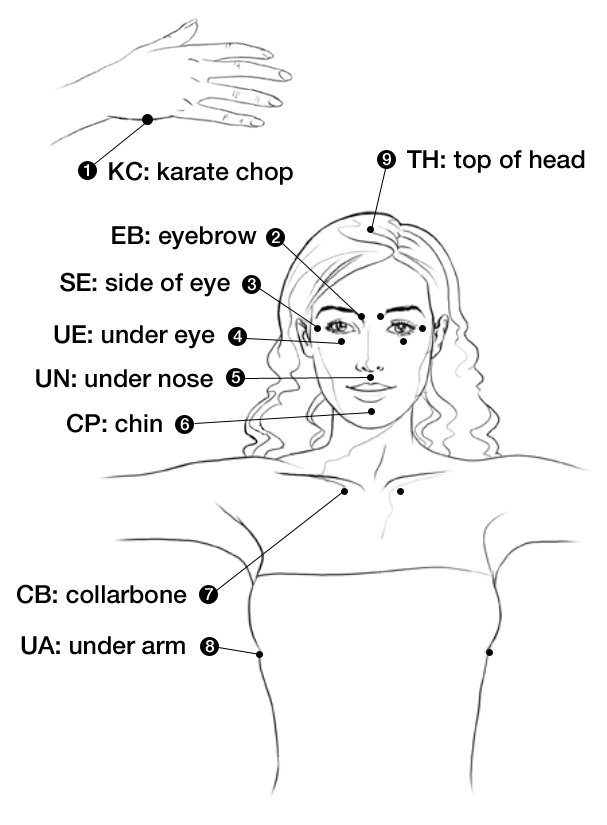
The crown, center and top of the head. Tap with all four fingers on both hands.
Eyebrow (EB)
The inner edges of the eyebrows, closest to the bridge of the nose. Use two fingers.
Side of eye (SE)
The hard area between the eye and the temple. Use two fingers. Feel out this area gently so you don’t poke yourself in the eye!
Under eye (UE)
The hard area under the eye, that merges with the cheekbone. Use two fingers, in line beneath the pupil.
Under nose (UN)
The point centered between the bottom of the nose and the upper lip. Use two fingers.
Chin (CP)
This point is right beneath the previous one, and is centered between the bottom of the lower lip and the chin.
Collarbone (CB)
Tap just below the hard ridge of your collarbone with four fingers.
Underarm (UA)
On your side, about four inches beneath the armpit. Use four fingers.
Head (TH)
And back where you started, to complete the sequence.
As you tap on each point, repeat a simple reminder phrase, such as “my anxiety” or “my interview” or “my financial situation.”
Now take another deep breath!
Note: This approach is different from traditional “positive thinking.” You’re not being dishonest with yourself. You’re not trying to obscure the stress and anxiety inside yourself with a veneer of insincere affirmations. Rather, you’ve confronted and dealt with the anxiety and negative feelings, offering deep and complete acceptance to both your feelings and your self. Now, you’re turning your thoughts and vibrations to the powerful and positive. That’s what makes Tapping so much more effective than the “positive thinking” techniques that many of you have already tried. It’s not just a mental trick; instead, you’re using these positive phrases and tapping to tune into the very real energy of positivity, affirmation, and joy that is implicit inside you. You’re actually changing your body’s energy into a more positive flow, a more positive vibration.
Here are some example phrases to guide you:
“I have faith in my ability to change.”
“I am joyful about these positive changes.”
“I am accomplishing so much.”
“I enjoy the calm and peace that I have.”
“I love the person that I am.”
“I am becoming a more relaxed and joyful person.”
You can use these positive phrases with the same tapping points and sequences described above.
Congratulations! You’ve completed your first Tapping sequence.
For more information on Tapping, make sure to fill out the form at the top or bottom of this page to receive the first 2 chapters of Nick Ortner’s new book “The Tapping Solution: A Revolutionary System for Stress-Free Living.”


 Copyright © 2026 The Tapping Solution, LLC





Connect With Us on Social Media