EFT Tapping: What It Is and How to Do It

A complete guide to EFT Tapping, written for beginners and backed by the research.

What Is EFT Tapping?

EFT tapping is a self-help technique where you tap with your fingertips on nine specific acupressure points on your face and body while you name what's bothering you, and that combination helps calm your nervous system, often within minutes. Its formal name is Emotional Freedom Techniques (EFT), sometimes shortened to tapping therapy, and it's free to learn.

I've been teaching this for almost twenty years. The first time I tried it, I felt a little ridiculous, tapping on my own face while talking out loud about a stiff neck I'd had for weeks. Fifteen minutes later the tension was gone, and I spent the next two decades trying to figure out why. That question turned into a documentary, two books, and The Tapping Solution app.

The 9 Tapping Points

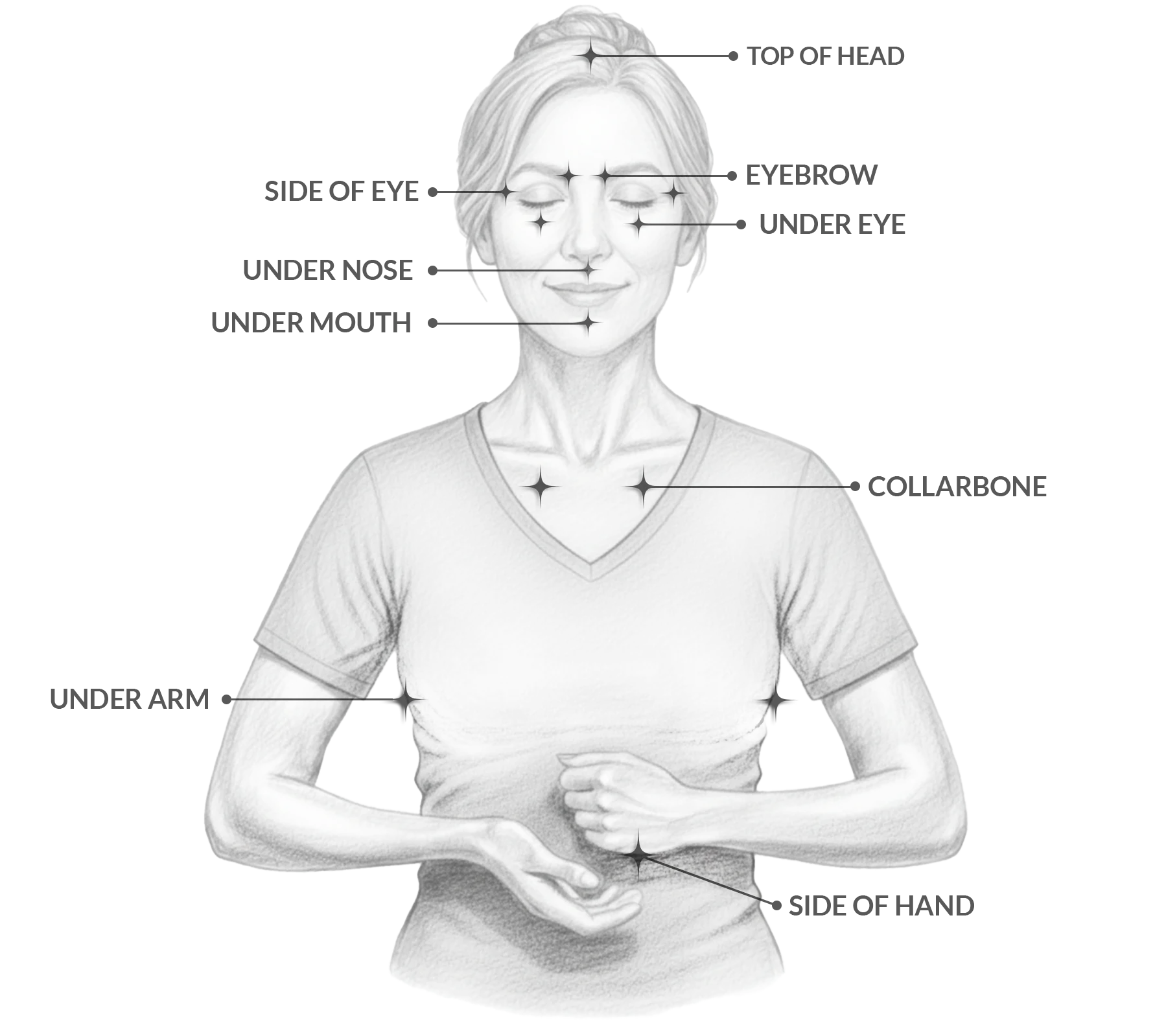
Tap on these acupressure points in sequence. Use your fingertips and tap gently but firmly, 5 to 7 times on each point. For exact locations, photos, and common mistakes, see our full EFT tapping chart.

The 9 Tapping Points Diagram
1

Side of Hand (SH)

The outer edge of your hand, between your wrist and pinky finger. This is where you say your setup statement.

2

Eyebrow Point (EB)

Where the eyebrows begin, closest to the bridge of the nose

3

Side of Eye (SE)

On the bone directly along the outside of either eye

4

Under Eye (UE)

On the bone directly under either eye

5

Under Nose (UN)

The area directly beneath the nose and above the upper lip

6

Under Mouth (UM)

Just below your bottom lip and above the chin, right in the crease

7

Collarbone Point (CB)

Starting from where your collarbones meet in the center, go down an inch and out an inch on either side

8

Under Arm (UA)

On your side, about four inches beneath the armpit

9

Top of Head (TH)

Directly on the crown of your head

How to Do a Round of Tapping

1

Pick Your Target

What's bugging you right now? Be specific. Instead of "I'm stressed," try:

  • This tension in my shoulders
  • I can't stop thinking about that meeting
  • This anxiety about my kids
  • I'm exhausted but can't relax
2

Rate the Intensity

On a scale of 0 to 10, how intense is this issue right now? Don't overthink it, just go with your first instinct.

3

The Setup Statement

We start by tapping on the side of the hand point, the fleshy part on the side of your hand, while saying a setup statement three times. The setup statement acknowledges the issue and helps neutralize any judgments you have around your experience.

A setup statement might sound like: "Even though [your specific issue], I acknowledge how I feel."

4

Tap Through the Points

Tap firmly but gently on each of the 9 points above while focusing on your issue. You can tap with either hand, on either side of your body or on both sides at the same time. To stay focused on the issue, you can repeat a reminder phrase (like "this anxiety" or "presentation stress"), or just give words to how you feel like you're sharing it with a friend.

Keep tapping through the points until you feel a shift.

5

Check In Again

Once you feel a sense of release, stop tapping and take a deep breath. Check in with yourself. What's your number now? Has anything shifted? If the number is still higher than you'd like, keep Tapping through the points until you feel greater relief.

6

Do a Positive Round (Optional)

Once your number is low, tap through the points again using positive statements instead of naming the problem. This round helps your mind and body register the calm you just created.

  • I have faith in my ability to change
  • I am joyful about these positive changes
  • I enjoy the calm and peace that I have
  • I am becoming a more relaxed, confident person

Want the fully written-out version, word for word, with a longer example round? Read our complete step-by-step tapping guide, or borrow phrasing from our tapping phrases and tapping scripts.

What the Research Shows

Tapping was developed in the 1980s by psychologist Roger Callahan, who found that stimulating acupressure points while focusing on a specific emotional issue could bring fast relief. In the 1990s, Gary Craig simplified Callahan's work into the single, universal sequence taught on this page, gave the manual away for free, and named it Emotional Freedom Techniques. That's still the version almost everyone means by "tapping" today. More than 400 studies have now looked at it (see the full research library), and a handful of findings show up again and again.

Start with cortisol, the body's main stress hormone, because it's a blood or saliva test, not a survey someone can talk themselves into. In a randomized trial, a single hour of tapping lowered participants' cortisol by 24% (Church, Yount & Brooks, 2012, Journal of Nervous and Mental Disease). A 2020 study set out to replicate that finding with a fresh group of participants, and it did: cortisol dropped 43% after tapping (Stapleton et al., 2020, Psychological Trauma). Two separate research teams, two separate samples, the same direction.

A systematic review and meta-analysis pooling 14 randomized controlled trials found significant reductions in anxiety among people who tapped, compared with control groups (Clond, 2016, Journal of Nervous and Mental Disease). For PTSD, a pooled analysis of seven randomized trials found a large effect of tapping against waitlist or usual care, with no significant difference from EMDR or CBT in the trials that compared them directly (Sebastian & Nelms, 2017, Explore). And in a 2022 systematic review covering 56 randomized trials, the authors reported no adverse events across the studies reviewed (Church et al., 2022, Frontiers in Psychology).

One more question worth asking directly: does it matter that you're tapping on these specific points, or would any calming touch do? Researchers have tested this head-to-head. In a randomized dismantling study of 56 stressed university students, one group tapped the real acupressure points and the other tapped sham points that are not part of the meridian system, with everything else kept the same. Stress dropped 39% in the real-points group versus 8% in the sham group (Rogers & Sears, 2015). An earlier trial (Fox, 2013) compared standard tapping with a modified protocol in just 20 students and was too small to show a clear difference, so the question is not fully settled, but the larger study points to the specific points mattering, not just the act of tapping.

Read the full case in our long-form guide on whether tapping really works or the deep-dive EFT tapping guide.

What's Happening in Your Body

A part of your brain called the amygdala switches on your fight-or-flight response. It's supposed to fire when you're in real danger, but for most of us it fires just as hard over a hard conversation, a full inbox, or a memory that won't let go. Stimulating acupressure points sends a calming signal to that same part of your brain (Feinstein, 2025, Energy Psychology: Theory, Research, and Treatment), which is likely why tapping while you name a stressful thought helps your body register that you're safe right now, while the thought is still active in your mind.

That pairing, holding the stressful thought while you send your body a signal of safety, is the working theory behind why tapping moves so fast. Your nervous system gets new information while the old alarm is still ringing, and that is what lets it stand down.

What People Use Tapping For

Anxiety and stress is what most people come to tapping for first, and it's also the most researched use case. Muminah wrote in after a session called From Fear and Worry to Peace: "I went from a 9 to a 1 and feel complete and utter Peace. Fears and worries I had melted away. Thank you!" (Rated 9 before, 1 after.) Across 4 million completions of our Emotional Freedom sessions, the average self-rated intensity goes from 7.0 to 4.1 (app data). Twenty years of watching people tap, and the pattern is always the same: the story that felt unbearable at a 9 is still true at a 1, it just doesn't run the show anymore.

Sleep is the other place tapping earns loyal converts, usually from people who've already tried everything else. Dayanna rated a session called Fall Asleep Faster (for Chronic Sleep Issues): "This was so good and relaxing. Starting to get better sleep already!" (Rated 10 before, 0 after.) Across 3.5 million completions of our Sleep Support sessions, the average self-rated intensity goes from 6.2 to 3.2 (app data). Stephanie's story shows the longer version of the same thing: one phrase during a session reached something decades of therapy hadn't. Sleep tapping rarely works by force. It works by giving the racing mind somewhere to land.

Chronic pain and physical tension bring people to tapping who are often already doing everything a doctor told them to. Darla, tapping through a session called Release General Pain, wrote: "very effective in voice, affirmations and music & more relief than the meds and other tools I'm using. Would Love to see more tapping on specific areas of pain, like sciatica - yet it is helping very much !" (Rated 9 before, 2 after.) Across 950,000 completions of our Pain Relief sessions, the average self-rated intensity goes from 6.3 to 4.0 (app data). Jean's story, a fibromyalgia story, follows the same arc. I've learned not to promise pain relief up front. Tapping works on the fear and tension wrapped around pain, and I've watched that shift happen for thousands of people over the years.

Cravings and emotional eating show up in tapping the way they show up in real life: messy and hard to talk about anywhere else. One app user wrote after a session called Getting Back on Track: "i needed this session i purposely sabbotaged my weight loss goals last night... i also know that tapping puts my mind in a better place which is half my battle. Thank you!" (Rated 10 before, 5 after.) Across 360,000 completions of our Weight Loss and Body Confidence sessions, the average self-rated intensity goes from 7.1 to 3.9 (app data). Amy's story shows what that looks like over decades, not just one session. The craving rarely disappears the first time. What changes is the shame that used to follow it.

Trauma, grief, and old memories that still sting bring the heaviest sessions in the app, and also some of the most quietly moving feedback we get. Mindy wrote after a session called Releasing Sadness: "I have held this sadness for decades. I feel stuck and in pain. This Tapping with Jessica helps me see it more clearly and hopefully I can release it. I feel blessed to have you in my life 🙏" (Rated 10 before, 4 after.) Across 54,000 completions of our Trauma Support sessions, the average self-rated intensity goes from 6.5 to 4.0 (app data). Victoria's story and Jane's story tell the longer versions. Twenty years in, here's what I've noticed: grief needs somewhere to move, and tapping gives it that.

A useful rule of thumb: if you can rate how a feeling shows up in your body from 0 to 10, it's a candidate for a round of tapping. If it needs a diagnosis, it needs a professional, alongside your tapping practice, not instead of it.

Is Tapping Safe?

For most people, yes. Tapping is a wellness tool that works well alongside therapy and medication, and a 2022 systematic review of 56 randomized trials reported no adverse events across the studies it covered (Church et al., 2022). Bring in a professional if you're working with significant trauma, a diagnosed psychiatric condition, or a physical symptom that hasn't been evaluated yet: tapping can support the stress and emotion wrapped around those things, but it doesn't diagnose anything, and solo tapping on major trauma can bring up more than it settles. That's exactly when a trained practitioner earns their keep.

What Our App Data Shows

Beyond the clinical trials, we have our own view into this: people have completed more than 32 million tapping sessions in The Tapping Solution app, and we've measured the before-and-after intensity on more than 18 million of them. In an independent study of 270,461 app users, tapping was associated with a 44% average drop in anxiety and a 45% average drop in stress (Church & Stapleton, 2020, JMIR mHealth and uHealth).

This is self-reported data from people who chose to use a tapping app, not a controlled trial on its own. But at this scale, alongside the research above, it's a real-world picture of the same pattern showing up outside the lab.

Beth described what a number like that looks like from the inside, after a session called From Fear and Worry to Peace: "It's grounding impact; from high energy anxiety to mild tranquility. WOW!" (Rated 9 before, 5 after.)

The app's own Intro to Tapping and The App (Start Here) session, built for people who are brand new to tapping, has been completed 41,742 times, with the average person's intensity dropping from 5.6 to 4.2, a 24% drop, in a single guided session.

Absolutely baffled! I'm literally fighting tears of joy to write this.

Brandi
C

Christina

Instant Boost of Happiness, in the app

"Your timing in my life at this moment is a miracle."
Intensity: 10 → 0

Ready to Try Guided Tapping?

Get 1000+ guided Tapping sessions for every area of life in our app. Perfect for beginners and experienced tappers alike.

Open Web App

Want to Understand the Science?

Now that you know HOW to tap, learn WHY it works

Go Deeper

Ready to build on the basics? Browse our full tapping points chart, our example tapping phrases, or a ready-made tapping script to follow word for word. If anxiety is your main target, our tapping sequence for anxiety is a good next stop, and our guide to calming your nervous system puts tapping in context alongside other tools.

Want to work with someone one-on-one? Find an EFT practitioner.

Frequently Asked Questions About EFT Tapping

Q: Does EFT tapping really work?

Yes, and not just anecdotally. I've watched thousands of people tap over the past two decades, and the research backs it up: multiple randomized trials and meta-analyses link tapping to real drops in anxiety, stress, and PTSD symptoms. Add more than 32 million sessions completed in our app, and the pattern holds at a scale no single lab study could ever reach on its own. It works best alongside good self-care and, when you need it, a clinician's care.

Q: Is tapping scientifically proven?

More than 400 studies have looked at tapping at this point, including randomized controlled trials and several meta-analyses on anxiety, PTSD, and stress biochemistry. The number I keep coming back to is cortisol: a single hour of tapping lowered it by 24% in one trial, then an independent team replicated that finding and got 43%. Two separate research teams, two separate groups of people, the same direction, and new trials keep coming out every year.

Q: Is tapping safe, and are there risks?

For most people, yes. A 2022 systematic review of 56 randomized trials reported no adverse events across the studies it covered, about as clean a safety record as you'll find for any wellness tool. Tapping works well alongside therapy and medication, so if you're managing a diagnosed condition, keep tapping as a companion to your clinician's care.

Q: How many times a day should I tap?

Whenever something spikes, plus once a day for maintenance if you can manage it. Most people I've talked with land somewhere between 5 and 15 minutes a day, and there's no known risk of doing too much. The problem I actually see is the opposite: someone tries it once, feels better, and forgets it exists until the next hard day.

Q: How long do you tap on each point?

Tap firmly but gently, 5 to 7 times on each point, saying a short phrase that keeps your mind on the issue. A full round through all 9 points takes about 90 seconds, so don't get hung up on counting taps precisely. Somewhere in that range is plenty.

Q: Can I do tapping on my own?

Yes. The 6-step process on this page is built to be self-guided, and most people pick it up in a few minutes. If you'd rather be walked through it, guided sessions in our app carry you through the words and the points, and some people layer in work with an EFT practitioner too, especially for bigger or older issues.

Q: What do you say while tapping?

Say what's actually true for you, out loud or in your head. Start with a setup statement on the side-of-hand point, something like "Even though [your issue], I acknowledge how I feel," then use short reminder phrases at each point, like "this tightness in my chest" or "this deadline stress." Save the positive statements for the optional round at the end, once the intensity has already come down.

Q: Why should tapping be avoided?

Tapping isn't the first move if you're in crisis, managing significant trauma without a trained practitioner's support, or dealing with physical symptoms like chest pain or sudden severe pain that haven't been medically evaluated yet. In those situations, reach out to a licensed mental health professional or your doctor first. If you're in the U.S. and having thoughts of harming yourself, call or text 988 to reach the Suicide and Crisis Lifeline. Tapping is built for everyday stress and emotion, not for emergencies.

Q: Does tapping conflict with religious beliefs?

No. Tapping is a physical stress relief technique, not a set of beliefs, so it sits alongside whatever faith or practice you already have. People from many religious backgrounds tap, and the words you say while you do it are your own, whatever they are.

Important Notice: The Tapping Solution App is intended for general wellness purposes, including stress management and emotional wellness support. It is not intended to diagnose, treat, cure, or prevent any disease or medical condition. If you have been diagnosed with a medical or mental health condition, please consult with your healthcare provider. This app is not a substitute for professional medical advice, diagnosis, or treatment.